My Good Name

© 2008 Brooke Allen
brooke@brookeallen.com www.BrookeAllen.com
Originally published in International Family Magazine
Republished in Folks Magazine on 8/22/09.

TwoBrookes
“Hello”

“Is Brooke Allen there?”

“Speaking.”

“I’m sorry, I have the wrong number.”

Click.

When I first moved to New York City a well-meaning friend gave me a book about surviving in the city. It served no purpose but to destroy all pleasure in life: When pushed in front of the subway, lie down in the ditch between the rails. Carry your wallet in your front pocket since your back pocket will be sliced open with a razor. And by all means, install three locks so the burglar finds your neighbor’s door more attractive.

Immediately after moving to the city, phone calls like the one above were repeated every week or two.

I was convinced that someone was casing my apartment and the instant I didn’t answer I would be robbed. What’s worse, since the caller’s voice sounded different each time it appeared there was an inexhaustible supply of crooks.

Two years into my torture one of my mystery callers explained it to me. There was another Brooke Allen who lived on East 88th street. Her number was unlisted and mine was.

I tracked her down. We exchanged phone numbers and thus began a long and entertaining relationship.

I would call her answering machine and play her messages on my machine.

I became comfortable acting on the various party invitations that arrived in my mailbox every so often.

“Who the hell are you?”

“Brooke Allen.”

One year I held a Christmas party. My friend called to say, “I’m confused. My sister-in-law received an invitation from you for the same date but a different location.” It appeared we had both friends and party dates in common.

Eventually we just held a joint party: Brooke Allen squared. Everyone might as well meet each other.

She is an established writer. When her play, “The Big Love” with Tracy Ullman opened on Broadway, I taped her poster on my office door.

“I had no idea you were you were so accomplished,” a coworker would comment.

“There are many sides of me you don’t know.” Yea, like that I’m shameless and I’ve never written a Broadway play.

When I wrote a letter to the New York Times, she got the comments.

When she wrote an essay in the Nation called “Our Godless Constitution” questioning the Religious Right’s right to claim we were founded as a Christian nation, I got the threats.

When I went to register for my MBA at New York University, they told me I was unwelcome there. It appears Brooke Allen had once been pissed at NYU, told them to get lost and put a stop payment on a tuition check.

While I was on vacation with a girlfriend, a friend of hers called my apartment and was told by our house-sitter that “They are in Europe.”

That friend them met Brooke at dinner and told her of the stranger on her phone. Only after she and the policeman found her apartment untouched did it dawn on her.

Revenge comes to all those who wait.

So tell everyone you know about that great writer, Brooke Allen. Tell them to look up Brooke’s books on Amazon and order them. Just don’t tell them she is not me.

Take pride in, protect and promote your good name, particularly if you share it with others.

Of Parks and People

© 2008 Brooke Allen
brooke@brookeallen.com www.BrookeAllen.com
Originally published in International Family Magazine

For this month’s Father’s Stories column I wrote a brief item about an incident in a park in Tokyo. I had wanted just one photograph of Arisugawa Park to illustrate my story but I could not find any.

So, I thought I’d write for help to some of the most wonderful people I know: members of http://www.couchsurfing.com (1.)   I will tell you more about them in a future article, but for now just know that this is a group of people around the world (about 400,000 strong) who build profiles describing themselves, as you might find on Facebook or Myspace. However, these people are exceptional; they are not into making “virtual friends” but real ones. They will meet you when you come to visit, show you around, perhaps take you for coffee, even put you up and more likely than not, stay up into the wee hours talking about the meaning of life.

I selected some members who live in Tokyo and who clearly enjoy photography. I wrote to them late the other day asking if they had photos of the park or if they lived near enough to go take some. By the next morning, a few had responded affirmatively and over the next few days the pictures started coming in; more than we could possibly publish here.

So now I have everything I need to tell you about and show you Arisugawa Park and what it means to me and to so many others.

Let’s begin with an excerpt from the Ministry of Education’s goals for the Moral Education of Children in Grade’s 1 and 2.  (2.)   Under “Things Primarily Related to Relationships with Nature and the Sublime” it itemizes:

(1) Feeling intimate with the nature that’s near oneself; being kind-hearted in treatment of plants and animals.

(2) Having a heart that values life.

(3) Having contact with beautiful things and feeling ennobled by them.

And under “Things Primarily Related to Oneself” is:

(4) Leading a life that is relaxed and ingenious, not dishonest or deceptive.

Arisugawa Park is clearly designed to help with all of these things.

The first time I entered the park was from the top of the hill. The children in front of me took off their shoes immediately; they knew this park is best experienced barefoot.

A bridge crossed a small stream that mysteriously flowed freely on the right but was not to be found on the left. (3.)  In a few short steps you were no longer in one of the busiest and most modern cities in the world. You felt like you’d come home to a time long ago.

There were birds to hear, trees to climb and hide behind, and flat open spaces for playing ball.

Then there was a playground. At first it looked like the playgrounds back home. But there was a difference. At home, the equipment was designed to avoid lawsuits; slides you can’t possibly fall out of, platforms with rails and all built on a rubberize pad.

It appears from the photos my Couch Surfing friends have sent that Arisugawa Park now has one of these too. This was probably inevitable given the number of Gaijin living in the neighborhood.

But I’m also glad to see all the old equipment is still there.

In 1990 the first thing I saw was a huge climbing frame with a tangle of children inside and on top. It is about 10 feet tall, and while you’d probably sprain an ankle jumping from it, your child would not. Kids are built to last.

You can watch children being ingenious and eventually you will learn that you need to relax.

The best place for a parent to park themselves is right in the middle on top. You can watch your child but you can not catch them when they jump. You can yell at them if you want but it will be purely for your own neurotic reasons since the other children will drown out your screeches. Soon you will discover that children are not idiots and they know what they are doing.

Then there are the swings. They look like swings in any other park in the world.

The difference between the swings here and the ones back home is evident only in the behavior of the adults. While tiny children can be strapped in to avoid injury, the bigger ones get a flat plank suspended between two chains that allow for some real fun.

On either side of the swings are some sort of painted metal pipes that seem to serve no purpose except to provide a hurdle to be cleared when a child jumps. Children soon learn that you can fly farthest from an upright position.

A path takes you down to a pond at the bottom of the hill.

Just looking at it is good enough for an adult but if you are a child you might want to go fishing. This is OK as long as you throw them back.

I wouldn’t try wading in if I were you. Nor would our sons; well – not twice.

Writing this story has been bittersweet for me.

Arisugawa Park, I miss you and I want to visit again soon.

I want to thank all the people from Couch Surfing who helped with photographs and suggestions for this piece: Niki, Yuval, Sarah, Aya, Mari, Alex, Jim, Takumi, Srini, Misaki, and Sylvie.

1. There is another group, about the same size, at http://www.hospitalityclub.org that is tied for First Place as having the Most Wonderful People.

2. Source: Catherine C. Lewis, Educating Hearts and Minds, Reflections on Japanese Preschool and Elementary Education, p. 46, Cambridge University Press, 1995.

3. Years later I decided to investigate and discovered that the water was re-circulated up to this point from pond at the bottom of the hill.


Love is a Mother

Children swinging in Arisugawa Park

© 2007 Brooke Allen
brooke@brookeallen.com www.BrookeAllen.com
Originally published in International Family Magazine

After we decided to move to Tokyo but before we all did, I went by myself to find us a home. I started by looking at playgrounds and parks.

Arisugawa Park is a lovely place, named for a Japanese prince. It has a flowing stream that starts at the top of a hill and ends at the bottom with a fishing pond. Its wonderful playground had many barefoot children playing in the clean dirt and on an assortment of equipment.

I observed two mothers and their young boys.

One mother looked Japanese and the other American. Their sons were playing on the swings. The boys were trying to go as high as possible. After a few minutes of building momentum, the Japanese boy flung himself from the swing. His mother saw this yet seemed unconcerned but the American mom interrupted the conversation, ran to her own child, and began scolding him. “Don’t you dare do what he is doing! You will hurt yourself.”

She returned to her friend. They resumed chatting and the two boys resumed swinging. As the Japanese boy would fly from the swing the American boy would look at his mother pleadingly. Twice more she interrupted her conversation to remind her son of what harm might come to him if he were to attempt a similar stunt.

Her behavior was beginning to annoy her Japanese girlfriend.

Then something amazing happened.

The Japanese boy went flying farther than ever before. He landed on a tree root and fell forward. He cut his chin on the trunk.

He began to bleed and cry.

The American mom immediately started to run, but her Japanese friend grabbed her by the arm and pulled her behind a bush. The Japanese mom watched her son intently through the leaves. As the boy looked around frantically, it was clear that he had no idea where his mother was hiding. The crying lasted but twenty seconds and the bleeding perhaps another thirty. Soon he composed himself, wiped the blood from his chin, and returned to the swing. While he still would jump from it, he now seemed to be more interested in precision than distance.

Breaking free, the American mom ran to her son. Waving her finger, she said, “See. That is what can happen to you.”

The American boy stopped swinging altogether. Then he began crying.

The Japanese mom wanted to continue their conversation, yet her American friend was too upset.

I made a point of walking past them on the way out of the park. I overheard the American woman say, “But I love my son too much.”

If you believe that loving someone and protecting them from all harm are the same thing, then you can love someone too much.

Party Time

© 2007 Brooke Allen
brooke@brookeallen.com www.BrookeAllen.com
Originally published in International Family Magazine

Have you ever held a party and had your first guest show up 45 minutes late? Did you have feelings of rejection and doubt? Perhaps nobody would come? Perhaps nobody likes you? Perhaps nobody ever did and they just got tired of being polite?
In some cultures, the feelings of others are more important than one’s own convenience.

John was a recent college graduate who was a member of my trading group when we moved from New York to Tokyo in 1992. The real estate market had recently crashed and with the housing budget provided by our employer, John was able to rent a three-bedroom apartment in Roppongi, the most desirable part of the city. Most Japanese “salarymen” could never aspire to live in such a place, even at the peak of their careers.

John decided to have a house warming party for himself.

He printed glossy invitations and handed them to everyone in the office. We were mostly Westerners and mostly male so, to balance the mix, he gave one to every beautiful young woman he ran across in Tokyo.

At 7:30 the doorbell rang. Fifty beautiful young women crowded the street in front of his apartment.

For more than an hour, John was the only male at his party and everyone felt a bit creepy, especially John. The women elected their best English speaker, “So, what is the deal? Is this party just all of us… and you?” John tried to explain that he’d invited lots of guys, but the ladies didn’t understand.

When the first male guest arrived after 9 PM he was greeted with a good deal of attention from the young women. By midnight, the sexes were fairly even and the party started to warm up. But John wasn’t having much fun because the females were shunning him.

In retrospect, John’s best tactic might have been to have a female friend play the role of host and for John to come to his own party at precisely 7:30. The women who arrived with him would not have viewed John not as creepy but rather as one of the rarest of all creatures: A Western male who was considerate of the feelings of others.


Arrive at the stated time. If you are the only one then you are either considerate or Japanese or both.

Mourning a Best Friend

© 2007 Brooke Allen
brooke@brookeallen.com www.BrookeAllen.com
Originally published in International Family Magazine

The first time I saw my dad cry was when Tallulah died. She was named after Tallulah Bankhead, the actress, because of their similarity of voice and propensity to drink from inappropriate vessels.[1]

Just as the best therapy following a miscarriage or stillbirth is to work on a replacement, my folks went downtown immediately and picked up Pookie.

My sister and I loved Pookie. She had only one neurosis. While she was indifferent to cars, she hated motorcycles and whenever she would catch up with one, she would try to puncture its back tire with her teeth.

We buried her in the backyard. This time I cried.

Then there was Charlie Brown, as dumb as a coconut and if you knocked on the top of the head he sounded like one. It is ironic that we gave CB to some astrophysicists who moved to Colorado; you’d think they would want be around smarties.

Tramp walked into our lives from the woods in the back. He played dumb and he fooled us for a season. Minutes after you would walk away he’d be tangled in the rope around the tree. I caught him out one day by watching from inside the house instead of going to his rescue. After twenty minutes of pitiable whining and yelping he stopped abruptly and unwound himself. He spent the afternoon playing at the end of his tether. One day Tramp returned to the woods and we never saw him again. We probably weren’t smart enough for him. He should have been the one to go to Colorado.

My wife doesn’t feel the way I do about dogs. She will tell you that she likes your dog, but she is just being polite. She doesn’t mean that she will like your dog if you give it to her. You’ve got to walk them or they crap in the house. They don’t last forever so they eventually crap out on you completely.

Once we all went to see My Dog Skip, a wonderful movie about a young boy whose emotional life was rescued by a dog. At the end our sons and I were crying. Eve’s arms were crossed and her head was shaking, “We’re not getting a dog. We’re not getting a dog.”

I’m sorry that my sons never had a dog. Dogs love life and are genetically engineered to be your friend. They aren’t as durable as you so they are likely to kick off before you do.


You can learn a lot about living and dying from a dog.[2]


[1] Ms. Bankhead famously drank champagne from her slipper at the Ritz hotel in London.

[2] Thorton Wilder said it better, “Many who have spent a lifetime in it can tell us less of love than the child that lost a dog yesterday.”

Fire Was No Stranger to Tokyo

© 2007 Brooke Allen
brooke@brookeallen.com www.BrookeAllen.com

Just before noon on September 1st, 1923, an earthquake struck Tokyo. Since so many people were using fire to cook their lunch, nearly the entire city was set ablaze. High winds (there was a typhoon just off the coast) spread the fires rapidly. More than half a million homes were destroyed and nearly two million people were left homeless. Over one hundred thousand perished.

During World War II, the 20th and 21st bomber commands repeatedly firebombed the city. On a single night (March 10, 1945) 279 B-29s Superfortress bombers destroyed 25% of the city and claimed another 100,000 lives.

In 1990 we moved from New York City to Tokyo. We had mixed feelings about finding a place near a Minato-ku firehouse. In New York, we had lived down the block from Engine Company # 5 where the friendly firefighters would let our children climb on their truck whenever we passed. On the other hand, we were frequently woken by their sirens.

Yet we never heard a single fire truck or even saw one on the streets of Tokyo for the nearly three years we lived there. To this day I can not tell you what one sounds like.

One night, we were having dinner at Tony Roma’s Place for Ribs (which is right next to the Hard Rock Café in Roppongi). At the adjacent table was an obviously American couple. We asked if they were tourists.

“Not exactly.”

“Are you on business?”

“Kind of.”

It turns out he was a fireman from Dallas, Texas. A philanthropist had paid for 50 firefighters (one from each State) to come to Tokyo to learn from the Japanese.

“How is it going?”

“Kind of weird.”  On Sunday night they had had a cocktail reception. Monday morning they visited a firehouse where they discovered that Japanese fire trucks were just like American, only smaller.

That afternoon the firefighters were taken to the Tokyo headquarters. They had expected to find high-tech computers but instead they were shown something out of the 50’s; a map with push-pins.

From Monday afternoon until the day when we met them (Thursday), the 50 firefighters were treated to boring lectures by the Fire Chief for all of Tokyo. Eventually they couldn’t take it any more and one of them asked, “When can we go out on a call?”

The Fire Chief responded, “We will go out on a call as soon as we have one. We haven’t had a call all week.” Apparently, they hadn’t had one for many weeks.

Eve and I were as flabbergasted. “How do they do that?” we asked.

“We asked the same question?”

And the Fire Chief’s response: “That is what I have been telling you all week.”

“So,” we asked our man from Dallas, “What did he say?”

“We don’t know,” he answered, “None of us were listening.”

So, I can not tell you why they have so few fires in Tokyo these days, but I can tell you why we have dozens, even hundreds, of calls each night in our major cities.

We don’t listen.

If someone is trying to tell you something, you should try to listen.

Mr. Rieur

© 2007 Brooke Allen
brooke@brookeallen.com www.BrookeAllen.com
Originally published in International Family Magazine

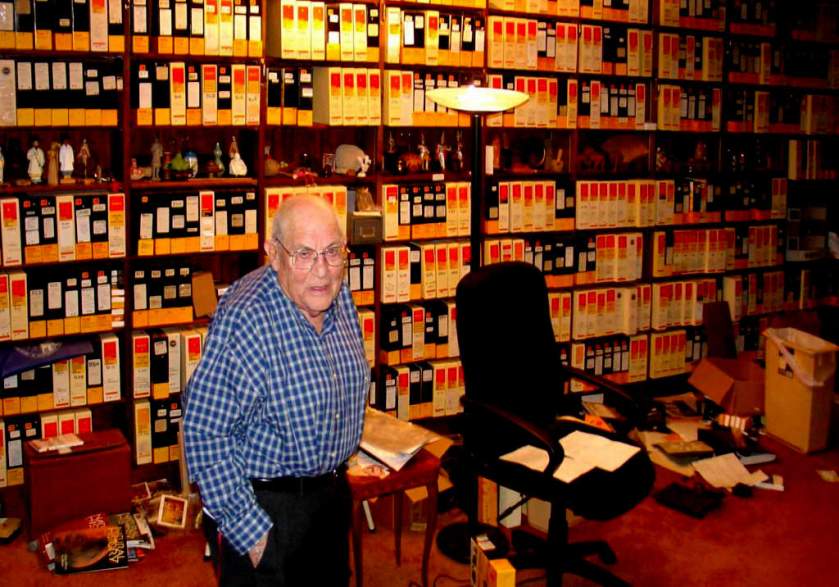
RieurIFM-1024x716LevelAdjusted
Mr. Rieur in 2007 at 89 in front of some of the 79,662 photos that he took on his world-wide travels that are now archived at the Consortium Library Library in Anchorage, Alaska.

You most want to be like the person you most admire. That is why, ever since 1963 when I had Mr. Rieur for the sixth grade I have wanted to be a teacher.

His classroom was unlike any other I’d seen before; across the inner wall were terrariums and fish tanks. In the back was a cabinet with his lab equipment and chemical supplies. The ledge by the window was lined with books.

He taught geography with slides and stories of his adventures visiting the places in our syllabus. We saw him standing at the Parthenon as it appeared in our book and then he showed us what Athens looked like from that spot. He taught how to live in the world and love its inhabitants.

We constructed the various types of fire extinguishers described in our science text. Then we used them to put out the fires we would set in the trash can behind the school. Our English assignment was to write a report about the experience.

It seemed like everything was connected to everything else and learning how things worked was fun; about the most fun you could imagine.

Since that time I’ve felt I couldn’t just live a life but I also had to pay attention; not because in the end there will be a test but because someday I’ll be called upon to teach others.

Those who can do, please teach.

P. S. On September 29, 2007, Mr. Rieur celebrates his 90th birthday. Please wish him well.

Sally Would be Proud of Me

© 2007 Brooke Allen
brooke@brookeallen.com www.BrookeAllen.com
Originally published in International Family Magazine

In 1993 I lost a job in Tokyo and returned to the States with a wife and two young children but no work.

Most of my contacts were no longer at the phone numbers in my book and many were unemployed. It appeared our economy was in a recession. A friend arranged for a courtesy interview at a brokerage firm I’d worked at years earlier.

Let’s call the interviewer “Bob”.

Bob began, “I hope we aren’t wasting your time but we have no jobs; there is a hiring freeze.”

“You have no work?”

“We have plenty of work, just no jobs. We can’t hire anyone except consultants on short-term contracts.”

“I would work as a consultant.”

“Are you incorporated?”

“No.”

Bob smiled, “Well then, I’m sorry but we can’t do anything. We only hire people who are incorporated. Thanks for coming in, but I have another meeting to attend to.”

“OK. How long will the meeting take?”

“About half an hour.”

“Well, I have nothing else to do today so perhaps we could talk some more when you get back. I’d be happy to help you if I can… no charge. In the meantime, may I use your phone?”

After he left, I called The Company Corporation, a firm that specializes in incorporating people in Delaware: Cost: $240 on a credit card.

When Bob returned I gave him a piece paper with my Federal Tax ID, “I am now Bravo Alpha, Incorporated.”

“What? I thought you said you weren’t incorporated.”

“That was then. This is now.”

“Why did you do that?”

“Because you said I needed to be incorporated.”

Bob smiled again, “Now I’m afraid you’ve wasted your time and your money. We won’t hire someone unless they are on our approved vendor list and that process takes months.”

I borrowed his phone again and called my friend at Galaxy Systems, an approved vendor. In a few minutes I was his sub-contractor.

Bob began to look worried, “We’re really backed up with work, but how do I know you can do it?”

I said, “That’s easy. I begin doing the work and you decide if I’m doing it as you want it done. At the end of the month, if you don’t think I am worth what I’ve billed, simply cross off my number and write in your own which can be any number including zero.”

Bob seemed shocked, “You would work for free?”

“Not exactly. If it turns out that what I am doing is not worth anything to you then I will ask you what I’m doing wrong. Learning what I am doing wrong is worth a month of my time.”

“How much do you want to make?”

“One hundred dollars per hour.”

Bob sighed, “That’s too bad because we are only allowed to pay a maximum of $87.50 per hour.”

“I would accept that.”

“But I thought you wanted to make $100 per hour.”

“I do. But I would accept $87.50. I would even accept $25 because I would rather work than not.”

Bob was incredulous, “OK, I guess I don’t see a reason not to hire you immediately except that it will take us weeks to get a contract written and approval isn’t certain.”

“No problem. I’m happy to start right away and bear the risk that you are never able pay me.”

I began work immediately. It sure felt better than being unemployed. The contract was approved and I was paid in full.

If someone says they want to do something, remove all their reasons for not doing it and they will see no other choice.

If you know you are worth something but an employer isn’t sure, then work on approval.

When you are stuck, think “What Would My Mentor Do?”

Learning How to Land a Job

© 2007 Brooke Allen
brooke@brookeallen.com www.BrookeAllen.com
Originally published in International Family Magazine

A mentor is someone who stands out in your mind as a model for your own behavior. If you find yourself thinking “What Would Sally Do?” then Sally is a mentor. Here is the story of my Sally.

In 1979, my boss asked for my help in replacing a secretary. Rather than pay a fee to an agency, Ted hired a temp and then advertised in the New York Times. We were flooded with resumes and some of these candidates had amazing credentials. He asked for my help in organizing the interviews so that he could make sure of hiring the best person.

One could type 130 words per minute. Another couldn’t type quite that fast but took dictation. Many had Bachelors degrees and a few had their Masters. I created a standardized form on which to record each candidate’s skills.

One day Sally rang our bell. She told our temp she wanted to drop off her resume in person.

“While I’m here, may I introduce myself to the hiring manager?”

Ted agreed to see her and asked me to attend. I’m glad he did.

“Tell me about your education.”

“I graduated from high school last year and I’ve had six months at secretarial school.”

Ted was unimpressed. “How fast can you type?”

“I’m not sure; perhaps 40 words per minute.”

“Hmmm. We have candidates with graduate degrees in English who can type over 100 words per minute.”

“Do you need me to have a degree and type that fast?”

“I don’t know, but it can’t hurt. Can you take dictation?”

“No. Do you give dictation?”

Ted stroked his chin. “Not yet, but some of these women can take dictation so I’m thinking about learning how to do it.”

“OK. If you want to learn how to give dictation, I’ll learn how to take it.”

Ted rose to say goodbye. I could tell that since he had not bothered to write anything in the skills survey he had no interest in her.

Sally stood, shook his hand and said, “May I ask a question?”

“Sure.”

“That girl who let me in; is she the one who is leaving or is she a temp?”

“She’s a temp. My previous secretary has already left.”

Sally looked directly at Ted, “I can do what she is doing and that is the kind of work I want to do. Tell her not to come in tomorrow and I will do her job for free while we both continue our search.”

Ted pulled me aside, “Can you think of a reason I should not take her up on this?”

Sally arrived the next day. She helped organize all the candidates and found typing and dictation tests for Ted to administer. Perhaps a dozen candidates made it into Ted’s final round and every one of them was better educated with stronger skills than Sally. Even with so many choices, Ted still couldn’t decide.

In the meantime Sally did everything that Ted wanted done. She couldn’t type very fast but fast enough. She made plenty of mistakes but she recognized them herself and corrected them. If asked for something at quitting time she didn’t do it first thing in the morning; she stayed late and did it.

After Sally had been working for two weeks, Ted pulled me into his office. “Can you think of a reason I should not give this job to Sally. After all, she’s already doing it.”

Ted hired her and gave her back pay from the day she first walked through our door.

I think that young woman taught me more about how to find work than anyone else.

Things I learned from Sally:


Don’t do the interview; do the job.


If you don’t like rejection, make offers that are hard to refuse.


Attitude trumps skill.


The best person for a job is the appropriate person for the job.


Work first and you shall receive.


Past Love

© 2007 Brooke Allen
brooke@brookeallen.com www.BrookeAllen.com
Originally published in International Family Magazine

I won’t tell you her name, but I will tell you when and where it hit me. It was in Latin class during the spring semester of the eighth grade.

She was beautiful and smart. What a wonderful smile. What a cheerful laugh. Blonde… blonde doesn’t hurt. Poised. Friendly. And smart… did I mention that.

We shared three other classes: Advanced Math, Science and History. How could I have not noticed her before?

At night, as I would go to sleep I could imagine our future life. We would study together. Tell jokes. Hold hands. Kiss, even.

She would be in a car accident and I would take care of her until she recovered.

I would develop a terrible disease and she would stay by my side in the hospital, holding my hand and crying. I’d pull through and we would swear to each other never to be apart.

We would marry.

Our love developed like this from the fall through the winter.

She must have noticed that I was staring at her.

One day she followed me to my locker.

She said, “Hi.”

I was mortified… struck dumb. “I… I…” I stammered, “I can’t talk to you right now. I’m very busy.”

I slammed my locker and ran down the hall. I’d hoped she thought I was needed somewhere in a hurry and that she would not think I was running from her.

That night I could not sleep. What was wrong with me? I was an idiot. Was that any way to treat your lover? She would never speak to me again.

I was right; she never did.

Any wonder? I had treated her badly. I avoided her path; her eyes.

My torture lasted through the summer. I don’t remember when it stopped. Mourning doesn’t end abruptly… it fades away.

I hoped she would never get over me and that she knew that I would one day become her one true love. I hoped she would see that right now I was needed elsewhere for a secret and extremely important assignment and she would wait for me.

So that is how I spent my eighth grade; the first half in the future and the second half in the past.

What a hell is immature love.

Love is found in the now, not in the then or the when.