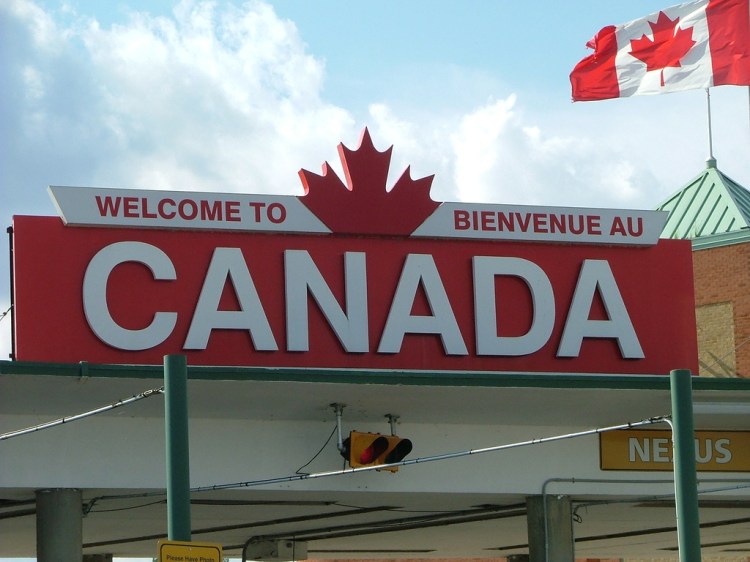
So, in February of 1971 we decided to hitchhike from Terre Haute, Indiana to Toronto by way of Detroit. A kindly gentleman in a pick-up truck offered to take us over the bridge to Windsor, on the Canadian side of the border.
He said, “If you are dodging the draft, don’t tell me, but I’m willing to try to get you across.”
At the border, the guards asked him who we were. “Just friends.”
We would have made it had our backpacks not been spotted in the bed of the pick-up. The three of us were interrogated in separate rooms. It was clear our driver knew nothing about us. “I’m sorry, but we are going to deny you admission to Canada. You must return to Detroit.” The official sounded quite official.
I felt like I’d been punched in the stomach. Then I felt guilty; I had just been treated as if I were a criminal. On top of this, I felt tremendous rejection.
Dennis seemed quite cheerful. “Great.” He said, “Would you write me a letter?”
“What?”
“I just want you to write me a letter rejecting me from Canada.”
“We’ve never done that before. I don’t even know what you are asking for.”
“Well,” He paused, “Since Junior High, I’ve been writing short stories and submitting them to literary magazines. I have not yet had a story accepted, but I have quite a collection of rejection letters from some of the world’s finest publications. However, this is the first time I’ve ever been rejected from an entire country. Would you write me a letter?”
The fellow laughed. “Why not?”
“Great. I’ll tell you what to say.”
——————————-
Dear Mr. ##########
Thank you so much for your submission to Canada. Unfortunately your offering does not meet our needs at this time.
We wish you the best in your endeavours.
Regards,
Canada
P. S. God Save the Queen
————————————
That night we managed to hitch to Oberlin, Ohio and spend the night in a house full of young co-eds. That was fun.
The next day we attempted to enter Canada for a second time, from Buffalo. The border guard spotted us immediately. A telex had been sent from Windsor describing two whackos.
As he pulled us out of the car, the guard said, “I suppose you’ll want another rejection letter.”
If you are going to go far, you’ll need to deal with lots of rejection. Start a collection.
In 1960, when I was eight years old, my parents bought a television. It was a black and white console model and it cost my dad about a month’s take-home pay.
It changed my life.
I could now entertain myself without friends, family, books or using my imagination. I could pretty much have fun without doing anything.
It started slowly but by the end of the decade that box had taken over our family. We would even watch television while eating dinner.[1]
In September of 1970 I went off to college in Indiana. For nine months I did not watch one second of television.
While flying home I practiced the first words I would say to my parents, “I have lived the greater part of a year without television. I will stay the summer in your house because I don’t have enough money to stay somewhere else, but I warn you that I refuse to watch television with you. There are so many more important things to say and do.” After my time away, I had so much I wanted to discuss with my folks, and the thought of competing with Laugh In,Ed Sullivan and the Million Dollar Movie both scared and sickened me.
“Dad, there is something I must say to you.”
“Sure, son. But first, are you still into ham radio?”
“Yes.” There was an amateur radio club at my college and I’d remained active.
“Do you still keep a junk box?”
“Yes.” A junk box is a large chest in which electronics enthusiasts place old equipment from which they hope to someday cannibalize parts. In the ninth grade I had taken apart a discarded television and rewired it as my first short-wave transmitter. Using Morse code, I’d been able to contact people in every state and dozens of countries with that “homebrew” transmitter.
“I’m glad,” he said. “The television is in the barn.”
It was in pretty good shape except that there was a bullet hole through the picture tube.
My family had figured out the same thing I had. One evening, after dinner, my dad gathered my mom and my sister around the TV and he shot it.
Usually, the best way to end an addiction is cold turkey.
[1] Warning: Extremely dangerous — do not try this at home.
It is important not to buy stuff you cannot afford.
I attended a presentation by a professor who talked about how, as a child, his Dad drove their cars into the ground even though their less successful neighbors purchased new ones every few years. His father said they could not afford new cars. The young man did not understand – they had enough money. His Dad said, “people afford what they want.” His father wanted him to go to college and that meant he could not afford new cars. His dad’s statement led to a career – Lowell Catlett is now Dean of the Agricultural Economics Department at New Mexico State University.
There is an infinite amount of stuff out there and even the wealthiest person cannot afford it all. To lust after things you cannot afford will make you unhappy. To buy stuff you cannot afford will make you broke.
There are different levels of how well you can afford what you want:
Level 0 – There is no way you can buy what you want.
Level 1 – Someone will lend you the money to buy what you want.
Level 2 – Your cash flow from what you are currently doing is sufficient to buy what you want.
Level 3 – The cash flow from the next best thing you could be doing is sufficient to buy what you want.
Level 4 – The interest on your savings is sufficient to buy what you want.
When I was a college student in 1970, nobody in their right mind should have lent me any money, and given that bankers then were in their right minds, they didn’t. Today, there is a huge industry devoted to getting people hooked on living at Level 1. These people think you should care about your Credit Rating, which is a mathematical score lenders use to determine if you can stay at Level 1 long enough to repay them. If you can’t cover your debts, you will discover that you have dropped to Level 0, even for things you have already bought, like a house or a car.
My parents started at Level 2, and they suggested that I want to be at Level 2 as well. They gave me $500 to start me out. My college lent me $1,000, but living at Level 1 was so scary that I paid that money back on my second installment. I’ve stayed at Level 2, or above, the rest of my life. Living at Level 2 used to be called “living within your means” before marketers convinced people that the ability to borrow money was a “means.”
A friend sends his son to private school. He makes enough money to do this without borrowing. I asked him if he would consider leaving his current job for another that pays less. He said he could not because then he could not afford the school. So, he can afford what he wants at Level 2, but he cannot afford it at Level 3 since he cannot afford to lose his job.
There are two ways to advance from Level 2 to Level 3. 1) Lower what you want enough so that if you lose your current job you can still afford what you want with the next best job available to you, 2) Advance to a higher paying job without increasing your wants.
Living at Level 3 allows you to accumulate wealth. This comes from saving the difference between the money you are receiving and what you are spending. At this point, you will view Credit Ratings in a different light – from the point of view of a lender.
You might even accumulate enough wealth so that you can live your life entirely from the money generated by your wealth. Then, you will be free to do anything you want as long as you do not start wanting things you cannot afford at Level 4. People who get to Level 4 live well in retirement.
Charlie Munger, Warren Buffett’s partner, was asked how he became so successful.[1] He spent his money to meet his needs, not his desires. He also worked very hard on increasing the value of his second best option (known to economists as “opportunity cost”). Charlie was 60 years old, and a multi-millionaire, before he bought his first new car. He lived at Level 4 before deciding that a new car smell was worth wanting.
Many of us have been living at Level 1 far too long, and are now in the process of dropping to Level 0. This is sad, particularly at a time when the second best option is also declining, in many cases to zero (unemployment).
There is a bright side.
We will learn how little we really need.
We will learn how much we need each other.
Before you want a thing, determine how much you really need it.
My mother was born in West Virginia and that made her an American citizen by birth. Her father was a naturalized German-American, and her mother was a native Italian. Her parents decided to raise her in Florence, Italy.
When it became clear that the Fascists were going down a path of no return, my mother and her father decided they had to get out of Italy. They flew to Lisbon on the last airplane to leave Rome before the airport was shut, and they crossed the Atlantic on the last passenger ship before German U-Boats began sinking them. They arrived in New York with little more than their clothes. My grandmother stayed behind in Florence, and she never saw her husband again.
A few days before I left for college, my father told me, “Your education is your most valuable asset.” I was seventeen, and I thought everything my father said was stupid, so I challenged him, “How can that be?”
He said, “Because your education is the only thing they can’t take from you at the border.”
You see, besides her clothes, my mother brought something else with her when she arrived in New York. She was fluent in Italian, French, German, Spanish, and English. She was good enough at math and science to enter university as a Physics major.
She was educated – and the Fascists could not take that away.
I have just returned from the annual meeting of the Chicago Quantitative Alliance (www.cqa.org) where one speaker made a convincing case that the brokerage and banking systems are bankrupt and another made the case that so is the Federal Government.
The world is going to hell, and we don’t even have a hand basket.[1]
At the lunch break I asked the fellow sitting next to me what advice he had for my children in college.
He said, “Drop out of college and learn a trade; they can always go to college later.”
That reminded me of a joke. A lawyer has a leaky faucet. He calls the plumber who fixes the faucet and presents a bill for $100.25.
The lawyer is livid, “How do you justify such an expense?”
“Twenty-five cents for the washer and $100 an hour for my time – one hour minimum.”
The lawyer says, “I’m a lawyer and even I don’t get $100 an hour.”
The plumber says, “That’s funny – when I was a lawyer, I didn’t get $100 an hour either.”
The joke reminded me of the advice my father passed on from his dad, “Develop both a trade and a profession.” Even as he rose through the ranks of management at United Press International, granddad maintained his skill as one of the world’s top telegraphers.
In 1990 we moved to Japan to advance my career as a securities trader, but in 1993 I was laid off and returned to the United States to find the nation in a recession. There was a dearth jobs that offered career prospects. Luckily, throughout my rise in management, I’d kept up my skills as a Pretty Good Programmer and quickly found that there was plenty of work for those who were willing to trade an honest day’s work for an honest day’s pay.
Don’t trade a chance at a trade for a profession – get both.
[1] For those of you who have not heard the expression, “Going to hell in a hand basket,” now you have.
Someone said, “Mardi Gras starts today.” Six of us shared a table for dinner at the small engineering college in Indiana.

I said, “Let’s go?”
Four people said, “Why?”
Roger said, “Why not?” Roger, who had grown up in Indiana, had only once ventured outside the state for a weekend in Chicago.
That snowy February evening our friends dropped the two of us on Interstate 70. All we had was $20 and our thumbs. Our friends gave us a phone number. “Call when you’ve had enough of this silliness and we’ll come and get you.”
The next day we called, “You can come and get us if you want.”
“Where are you?”
“New Orleans.”
That day my life changed.
“Why don’t we take a trip around the world next week?”
“Why not?”
“Why go to graduate school?”
“Why not?”
“Why get married?”
“Why not?”
“Why change careers without notice?”
“Why not?”
“Why have children?”
“Why not?”
“Why move your family to Japan for a few years?”
“Why not?”
“Why are you writing this?”
“Why not?”
My world opened up on that freezing day in 1971 when I changed how I react to opportunity.
My parents and the silver Jaguar they were about to sell because my mother was pregnant with me and they needed the money
My father told me two things about money that had a profound effect on my life. They were:
“Money should buy freedom, not chains.”
and,
“It is easier to make money doing what makes you happy than to buy happiness with the money you are paid for doing what makes you miserable.”
Even though I can remember my father’s explanations, at the time (age 17) I thought he was off his rocker.
He explained that if you had a certain amount of money, and then someone gave you more money, you should have more options open to you.
This seemed self-evident, but I didn’t buy the part about chains.
Imagine someone who always wanted to be a school teacher who, in order to make more money, became a principal, then moved to the private sector as a salesman, manager, and finally a senior vice-president earning ten times his potential salary as a school teacher.
Since our hypothetical teacher had given up teaching for more money, you would expect that finally, as a highly paid executive, she (or he) should have plenty of money to finally fulfill an ambition of being a teacher without the money worries that plague most teachers.
But for nearly all, such a person sees their options dwindle rather than expand. They measure their success in how much money they make and the prestige that comes with position. From Senior Vice President, they only want to become President.
Worse yet, this person often borrows against an expectation of a rosier future and finds themselves a slave to home payments, credit card debt, private school bills, college tuition, and the economic cycle.
I recently had lunch with a friend who has started a financial consulting firm. His distinguishing feature is that he will tell his clients the truth rather than what they want to hear.
He said, “Ninety-percent of Americans live beyond their means — no matter what their means.” He gave an example of a client in mid-life who was worth $15 million from which he earns $650,000 a year. However, he spends $1.2 million a year and he wants my friend to find him a safe investment to support his lifestyle. This is a mathematical impossibility. My friend could calculate how quickly the client will find himself on welfare.
I wonder how much misery must this client need to overcome when $650,000 a year doesn’t do the trick.
I like to end these pieces with succinct words of wisdom. I can do no better than to repeat what my dad said to me during my Senior year in High School, just before he gave up a career in the business world to return to sculpture full-time.
Money should buy freedom, not chains.
It is easier to make money doing what makes you happy than to buy happiness with the money you are paid for doing what makes you miserable.
In 1977, American Airlines offered me a job in Manhattan in their Operations Research group and I took it.
One of our projects was to build a mathematical model to determine how much we should overbook each flight so as to maximize profit. You could generate happy clients when there isn’t enough room in coach by bumping them up to first class. But if you throw them off the plane entirely you might lose them forever.
On the other hand, since a full-fare customer could use their ticket on any airline at any time without penalty, if you kept a seat open for everyone who said they would fly with you then your planes would fly half-empty. It was an economic necessity to overbook, and every airline did it, but I was not about to tell my friends about this part of my job. Nobody really thought an airline should promise something and then not deliver. Nobody. Including me.
Fifteen years later, we found ourselves living in Tokyo and planning a visit to relatives in England. I made a reservation on Japan Airlines but, after we realized that the flight landed at a very inconvenient time, we made a second booking on British Airways.
Upon return, as we walked through the door to our home in Tokyo, the phone was ringing.
“Hello, is this Mister Allen?”
“Speaking.”
“Are you OK?”
“I’m fine.”
“And your family; is everyone all right?”
“Sure. Who is this?”
“This is Japan Airlines. A week ago you had a reservation on our flight from Tokyo bound for London’s Heathrow airport. You didn’t show up. We held the plane for 15 minutes and you still didn’t come so we took off without you. We can make up fifteen minutes in the air but eventually we had to go because it would be inconsiderate of our other passengers to wait any longer. We just want to make sure you are all well.”
“We’re fine. We flew on British Airways instead.”
“You flew on British Airways?”
“That’s right. We had full-fare tickets and they are good on any airline.”
“That’s true. But you didn’t tell us.”
“We don’t need to tell you. We can use our tickets on any airline at any time.”
“That’s true too. But, by not telling us, you were being inconsiderate.
Just because you are a customer does not make you always right.
The graph depicts four indices for six years on either side of a peak. They are: BLUE : Dow Jones Industrial Average (center: September, 1929), YELLOW: Japanese Nikkei 225 Stock Index (Center: December, 1989), GREEN: Nasdaq 100 Stock Index (Center: March, 2000), and RED: S&P/Case-Shiller Home Price index for Miami (center: May, 2006… ending November, 2007)
Experience has convinced me that there are three phases to the economic cycle:
Phase I – A period when it seems that everything you do succeeds
Phase II – A period when it seems that nothing you do succeeds
Phase III – A period when success depends on what you do
If you’ve studied the Roaring Twenties, Japan in the 1980s, the Dot.com bubble of the ’90s, our current housing market[1] – or even a gravity propelled roller coaster – then you know the slow climb of Phase I deserves to be the scariest for the worst is yet to be.
If what you are doing is working well you then you might convince yourself that you don’t need to learn anything new or do anything differently. You might be seduced into believing that it is wise to mortgage your future for an even more wonderful present. Fact is; these are the best times to save for bad times.
Eventually a hill will be crested that leaves nothing but a cliff in sight and if there is another hill in the distance the fog will be too thick too make it out. Phase II has begun.
During these times people have no trouble feeling fear and remorse but those feelings do them no good. If you’ve lost a job, you might conclude that no equivalent one exists to replace it, and you might be correct. People will switch from mortgaging their future to scrimping to make ends meet. Since no investment seems to pay a return, they stop investing and since nothing they do seems to work, they stop doing anything. These are symptoms of depression, both economic and emotional.
Eventually there comes a time when your investments do begin to pay off and success does depend on what you do. This is the beginning of Phase III.
How well your investments perform in Phase III depends on what you invested in during Phase II. You might object that during Phase II many people no longer have resources to invest. But, they have clear title to a brain and they own their own time. If nothing you do pays a current dividend then there is no opportunity cost to investing effort and time honing old skills and learning new ones.
The degree to which your efforts pay off depends on what you are capable of doing. What you are capable of doing in Phase III depends on what you were doing during Phase II.
Out of necessity, my grandmother had become a real estate agent in the early 1930’s during a bad time to be one. Homes didn’t begin moving until the economy turned around, but when it did, she had mastered her craft, she had the prospects and she was on the job. Within seven years they owned a spectacular house of their own free-and-clear whereas had they used their meager savings to buy a house in 1928 then by 1937 they would be about 9 years into a 30 year mortgage and my grandmother would still be without a career — assuming, of course, they didn’t lose everything to the bank as did so many of their peers.
My grandfather kept his job at the United Press by volunteering for multiple pay cuts. Things didn’t open up for my Granddad until the environment improved, but when it did, he was there in the office with needed skills while others were still waiting things out.
If, during Phase I, you avoid having too high an opinion of yourself or too much confidence in the future but instead continue to evolve your skills and save for Phase II, then you will be better able to weather and adapt to hard times.
If, during Phase II, you continue to invest in yourself and work for the benefit of others even though your efforts are not immediately rewarded, then you will be in the best position to prosper when Phase III inevitably begins.
If you follow, believe in and espouse this Three Phase Theory, then:
During Phase I you will have been labeled a contrarian and a pessimist.
During Phase II you will have been thought a fool for working so hard without reward.
However, during Phase III, when prosperity seems to shine on you before others, you will be heralded as a genius and visionary.
It is what you do when it seems that nothing matters that determines your success later when you discover that it does.
[1] Note: The Yellow line (Japanese market) is the best illustration of my theory since Phase III doesn’t go down as far and is flatter after it stops rather than “bounces.”
I lived in Japan for Phase II and although the Japanese government tried to manipulate the market. I believe they succeeded in engineering a soft landing but they didn’t manipulate the market for a recovery, which I believe is wise.
In the 1920’s and 30’s (the Blue line) the market ran up just as much in the Roaring 1920’s as it did in Japan in the Roaring 1980’s. But the USA then fell more than Japan in the next few years and then government interventions helped with a recovery.
The Dot-Com bubble of the 1990’s was a bigger bubble than in the 1920’s and the collapse that started from the high in 2000 was more severe. While, in the lingo of so-called analysts, the collapse was a “correction” and the recovery from the low was due to “over-shooting” I believe the truth is that the so-called recovery is the beginning of another Phase I bubble rather than what some people call a “consolidation” and what I call Phase III.
If you want to experience the the the Red Line (Case Schiller Real Estate Index adusted for inflation) as a literal roller coaster ride then look at the Real Estate Roller Coaster video published in April, 2007. You can see it here: https://www.youtube.com/watch?v=kUldGc06S3U
This article was first published in May, 2008 in a publication called International Family Magazine that is now defunct. It is reproduced here with changes made over the years to correct typos and improve readability but the graph and the text describing the theory are unchanged from the original.
I formulated the theory in the 1980s and used it professionally and personally every since. At that time I was employed by Merrill Lynch in NY from 1986-87(Phase I) and kept my job through 1988-90 (Phase 2). Then I moved to Japan with Merrill and worked during Phase II there. I returned to the U. S. A. in 1993 during the depths of recession and bought a house for cash, which turned out to be perfect in retrospect since I timed Phase III within a few months of its beginning.
I was running a hedge fund during the dot-com bubble burst in 2000 and because of this theory we flourished when many peers went belly up. Like my grandparents we own two houses free-and-clear (one for weekday use near a good school and another in the country). There is no way we’d buy real estate during during what is obviously the beginning of Phase II.