Learning How to Land a Job

© 2007 Brooke Allen
brooke@brookeallen.com www.BrookeAllen.com
Originally published in International Family Magazine

A mentor is someone who stands out in your mind as a model for your own behavior. If you find yourself thinking “What Would Sally Do?” then Sally is a mentor. Here is the story of my Sally.

In 1979, my boss asked for my help in replacing a secretary. Rather than pay a fee to an agency, Ted hired a temp and then advertised in the New York Times. We were flooded with resumes and some of these candidates had amazing credentials. He asked for my help in organizing the interviews so that he could make sure of hiring the best person.

One could type 130 words per minute. Another couldn’t type quite that fast but took dictation. Many had Bachelors degrees and a few had their Masters. I created a standardized form on which to record each candidate’s skills.

One day Sally rang our bell. She told our temp she wanted to drop off her resume in person.

“While I’m here, may I introduce myself to the hiring manager?”

Ted agreed to see her and asked me to attend. I’m glad he did.

“Tell me about your education.”

“I graduated from high school last year and I’ve had six months at secretarial school.”

Ted was unimpressed. “How fast can you type?”

“I’m not sure; perhaps 40 words per minute.”

“Hmmm. We have candidates with graduate degrees in English who can type over 100 words per minute.”

“Do you need me to have a degree and type that fast?”

“I don’t know, but it can’t hurt. Can you take dictation?”

“No. Do you give dictation?”

Ted stroked his chin. “Not yet, but some of these women can take dictation so I’m thinking about learning how to do it.”

“OK. If you want to learn how to give dictation, I’ll learn how to take it.”

Ted rose to say goodbye. I could tell that since he had not bothered to write anything in the skills survey he had no interest in her.

Sally stood, shook his hand and said, “May I ask a question?”

“Sure.”

“That girl who let me in; is she the one who is leaving or is she a temp?”

“She’s a temp. My previous secretary has already left.”

Sally looked directly at Ted, “I can do what she is doing and that is the kind of work I want to do. Tell her not to come in tomorrow and I will do her job for free while we both continue our search.”

Ted pulled me aside, “Can you think of a reason I should not take her up on this?”

Sally arrived the next day. She helped organize all the candidates and found typing and dictation tests for Ted to administer. Perhaps a dozen candidates made it into Ted’s final round and every one of them was better educated with stronger skills than Sally. Even with so many choices, Ted still couldn’t decide.

In the meantime Sally did everything that Ted wanted done. She couldn’t type very fast but fast enough. She made plenty of mistakes but she recognized them herself and corrected them. If asked for something at quitting time she didn’t do it first thing in the morning; she stayed late and did it.

After Sally had been working for two weeks, Ted pulled me into his office. “Can you think of a reason I should not give this job to Sally. After all, she’s already doing it.”

Ted hired her and gave her back pay from the day she first walked through our door.

I think that young woman taught me more about how to find work than anyone else.

Things I learned from Sally:


Don’t do the interview; do the job.


If you don’t like rejection, make offers that are hard to refuse.


Attitude trumps skill.


The best person for a job is the appropriate person for the job.


Work first and you shall receive.


Past Love

© 2007 Brooke Allen
brooke@brookeallen.com www.BrookeAllen.com
Originally published in International Family Magazine

I won’t tell you her name, but I will tell you when and where it hit me. It was in Latin class during the spring semester of the eighth grade.

She was beautiful and smart. What a wonderful smile. What a cheerful laugh. Blonde… blonde doesn’t hurt. Poised. Friendly. And smart… did I mention that.

We shared three other classes: Advanced Math, Science and History. How could I have not noticed her before?

At night, as I would go to sleep I could imagine our future life. We would study together. Tell jokes. Hold hands. Kiss, even.

She would be in a car accident and I would take care of her until she recovered.

I would develop a terrible disease and she would stay by my side in the hospital, holding my hand and crying. I’d pull through and we would swear to each other never to be apart.

We would marry.

Our love developed like this from the fall through the winter.

She must have noticed that I was staring at her.

One day she followed me to my locker.

She said, “Hi.”

I was mortified… struck dumb. “I… I…” I stammered, “I can’t talk to you right now. I’m very busy.”

I slammed my locker and ran down the hall. I’d hoped she thought I was needed somewhere in a hurry and that she would not think I was running from her.

That night I could not sleep. What was wrong with me? I was an idiot. Was that any way to treat your lover? She would never speak to me again.

I was right; she never did.

Any wonder? I had treated her badly. I avoided her path; her eyes.

My torture lasted through the summer. I don’t remember when it stopped. Mourning doesn’t end abruptly… it fades away.

I hoped she would never get over me and that she knew that I would one day become her one true love. I hoped she would see that right now I was needed elsewhere for a secret and extremely important assignment and she would wait for me.

So that is how I spent my eighth grade; the first half in the future and the second half in the past.

What a hell is immature love.

Love is found in the now, not in the then or the when.

Science Takes a Look at Love

© 2007 Brooke Allen
brooke@brookeallen.com www.BrookeAllen.com
Originally published in International Family Magazine

In June of 2006 I had dinner with a young newlywed couple in London, England. They had just read my story, How Grandmother Won Granddad in a Beauty Contest, in the May issue of International Family Magazine.

The young bride asked me, “How do you know that you’ve met that one person out there who is just perfect for you?”

I don’t know the answer, but I find the question very disturbing since it implies that there is only one perfect person; yet it is likely that if you’re going to be married for any length of time there will be plenty of opportunity to uncover your mate’s imperfections and convince yourself that you’ve stopped looking too early.

This March I was again in London and again I had dinner with another newly married young couple. They too had read the story of my grandparents. She was beautiful and literate. He was handsome and charming. They held hands, snuggled and kissed a lot

Like my grandparents, they had married within weeks of first meeting.
Isn’t it romantic?

I think so.

But also scary.

I couldn’t put my finger on it until I read the book, The Happiness Hypothesis by Jonathan Haidt, a psychology professor at the University of Virginia. The book discusses the science of happiness. In his chapter Love and Attachments he explains that long-term relationships must be based on companionship, not passion. You just aren’t physiologically capable of extended bouts of passionate love; you’ll develop tolerance to the dopamine you’re producing.

Thinking back, my grandparents never talked about youthful passion. They talked about the great adventures they had together and they talked about how lonely they were before they met.

But passion?

Nope.

For a love to last a long time you must be long time companions, not just lovers.

Advice for Grandchildren

© 2010 Brooke Allen
brooke@brookeallen.com www.BrookeAllen.com
Originally published in International Family Magazine


After my dad died, I went through his hard drive and found this in a folder named: adviceforgrandchildren


Title: Boys and Girls


Until about 2 years old


I have noticed that children at this age carry on soundless interested communication sometimes pointing and laughing and crying from their strollers regardless of whatever color (blue or pink) they are wearing

3 and 4 years of age


Very friendly to all their peers regardless of age sex or economic level. Not very intellectual communication except for world shaking statements, like ” Why?” and “If people believe in God and all the people die; What happens to God?”


5 to 12  years of age

A great age of discovery about boys and girls by boys and girls. Boys feel sorry for girls because they don’t have one. Both have long hair some times. Some boys notice older girls have bumps on their chest. Boys don’t like girls and girls don’t like boys. Sometimes they have separate school gangs or social clubs. Girls sometimes wear dresses but boys never do, except in Scotland and Greece. Both use separate toilets except in some countries that usually have a cement hole in the ground with two foot prints in the cement.


13 to 18 years of age

Boys voices change and they start (hopefully) growing beards, develop into couch potatoes with pot bellies and are slobs. Girls become attractive by taking care of themselves, working out and learning how to make up. Girls make better grades than boys. All are an absolute trial for parents – usually – but not always. Some teenagers are nicer than their parents were at the same age. At first, for boys and girls, is confusion then fascination or extreme dislike of either themselves or the opposite sex. Hormones almost take over completely, but not quite. There is school sex education but that is series of biology lessons and common knowledge which is usually incorrect.

What one must do is learn how to be a lover. This simply means making sure the other person is happier or more satisfied than you are. An adjunct to learning this is how to be a friend to boys and girls without a sexual meaning.


If you learn these lessons you will be happy or create happiness for the rest of your life.


19 to 22 years of age


A time to learn ‘HOW TO’:

  • How to think with and without the influence of your hormones.
  • How to get to know the opposite sex.
  • How to find out what you want to like.
  • How to court the person of your attention.
  • How to make a living so that you can support yourself and the result of all those hormones and frantic attention to the opposite sex.

23 to 60 years of age


Your internal clock goes off !

And you did not even know you had one.

It is called parenthood.

You will have to find your own way. There are some things you will find out all by yourself. We are all individuals – even our loved ones.

Some observations are classical and catholic:

Birds make much better parents than people; they know when to kick the chick out of the nest, after together knocking themselves out taking care of each other and the chicks.

Children cause one to appreciate one’s own parent.

Adulthood means accepting responsibility regardless of how you feel or resent it.

61 to 70 years of age


Freedom!

You can set your own schedule.

You can not get fired because you are retired.

You have little or no sex.

You can speak you mind, but few listen.

You realize how much you love your mate as they pretend to listen.

After 70 years of age


I have noticed that grown people this age carry on loud uninteresting communication sometimes  pointing and laughing and crying from their wheelchairs and canes regardless of whatever sex or color their hair is.

Hoping for death with dignity.

Love,

Your granddad Tom.


If someone is not ready to hear what you have to say, write a memo.

The Magical Power of Imagination

© 2007 Brooke Allen
brooke@brookeallen.com www.BrookeAllen.com
Originally published in International Family Magazine

As an undergraduate I went on a date to see a famous “mentalist”. I find magicians entertaining. My date was eager to show me proof of the supernatural. I was entertained and she found her evidence.

His first feat was to control the minds of two volunteers. He had asked the promoters to provide a selection of decks of cards. Two volunteers each chose a deck and shuffled them. The volunteers sat at desks a few feet apart, each with a face-down deck.

The mentalist then remembered that the effect was difficult if the decks contained any jokers so he quickly removed them.

Each volunteer was asked to cut the deck about a third of the way into the pack and turn those cards over, placing them face up on top of the rest of the deck. Then they were to repeat the process, cutting past the face-up cards and turn them over again.

Finally, he used his mind to command the volunteers to remove the face-up cards so as to find the first face-down card.

Amazingly, they both had found the eight of clubs.

“See,” said she.

“I see,” said I.

He asked the audience to think of a number between one and one hundred, both digits odd but not the same. For example, 15 and 91 would be OK but 55 was not. We all thought of a number.

“I can sense many of you are thinking of 37… or perhaps 73. Raise your hand if I am right?”

Many hands went up. Not all, but certainly more than one percent.

She was thinking of 37.  I was thinking of 88. She was much better than me at following instructions..

“Do the math,” she said.

“I have,” I said.

I left amused. She left with a renewed faith.

While in graduate school I saw an act called the Asparagus Valley Cultural Society featuring two magicians who would later work together as Penn and Teller. They claimed to be no more than entertainers. They were very entertaining.

In 2005, thirty years after first seeing him on stage, I heard Penn Jillette’s essay on National Public Radio entitled “There is no God.”

http://www.npr.org/templates/story/story.php?storyId=5015557

Like many people, he and I believe there is no God.

But I do believe in providence even though one definition is: “a manifestation of God’s foresightful care for his creatures.”

In high school, I imagined I would find something in college that would excite my passions. Three years later I did.

I imagined I could make a living at it, and for thirty years I have.

I imagined I would find a woman to love and ten years later I did.

We imagined having wonderful children and we have.

I imagined writing stories for them and I have.

I imagined that someone would be interested in publishing some of those stories and at Sea-Tac airport I met Catherine Wayland and she did. Here they are.

If you imagine that there is a foresightful God looking out for you, you will find ample evidence that there is. Even if there isn’t.

You don’t need to believe in God to trust in providence.

College Thinking

© 2007 Brooke Allen
brooke@brookeallen.com www.BrookeAllen.com
Originally published in International Family Magazine

Colleges have become marketing experts. They work very hard at convincing you to send them your child and your money. You have to do the work yourself to find out why you shouldn’t send them either.

“Admissions.”

“Hello, is this (name of a liberal arts college in the Midwest)?”[1]

“Yes it is.”

“Are you an admissions officer?”

“Yes I am.”

“I am calling regarding my son. He has been admitted to your institution and he’s trying to decide if he wants to go. He isn’t here now so do you mind if I record this conversation for him?”

“Not at all.”

“Great. My son is a very good student but he is not yet ready to narrow his interests. He feels that a liberal arts college might be just the thing for him, at least as an undergraduate.”

“We fit the bill.”

“Personally, there is only one thing that I’m hoping he gets out of college more than anything else.”

“What’s that?”

“I would love it if he learns how to think.”

“Excellent. We’re in agreement. More than anything else, that is what we’re all about.”

“I’d like him to learn how to tackle problems with insight and creativity.”

“We agree.”

“I’d like him to respect authority and yet feel comfortable questioning it.”

“Perfect.”

“I’d like him to develop his people skills and to become responsible.”

“Couldn’t agree more.”

“I’d like him to learn to make his own decisions without requiring the approval of his peers.”

“We teach independence and responsibility by example. The college puts a great deal of trust in its faculty, staff and students to make decisions on their own.”

“I’d hope that he’ll find a place that facilitates this process rather than gets in the way.”

“That describes us to a T.”

“Good. Now, I have a question. Do you require that freshmen live on campus?”

“Actually, we require all students to live on campus their first two years.”

“No exceptions.”

“Well, we do make rare exceptions for hardship.”

“Do you mean, as in a case where we live in town but we don’t have enough money to pay for tuition and room and board? However, we could swing it if he lives at home.”

“We feel very strongly about this. We’ve found it is important for freshmen to develop strong relationships with other freshmen and these relationships are solidified in their second year. So, in the case of financial need we’d give him enough aid so that he could live on campus.”

“Like a grant?”

“Or a loan.”

“Ok, so you feel it is so important you would have him to go into debt. Now, imagine that the fact is that he has inherited a house right in town. It has four bedrooms and it has a market value of $160,000. Your college costs $47,000 a year all in. Since he has clear title, I doubt he’d qualify for a grant based on financial need. Are you saying you’d force him to sell the house and still go into debt so he could give you the money and live on campus when he’d rather take roommates and live in his house?”

“No. That would certainly qualify for an exemption. He could have seven other roommates since the town zones houses that way for students. He could collect enough rent from his roommates to pay all his other expenses.”

“That’s what it seems like. Rather than liquidate the house and give you all his money he could graduate from college with an education and a house free and clear.”

“Correct. And managing a property like that will certainly teach him responsibility. I’m sure I could get an exemption for him.”

“And seven other students.”

“What do you mean?”

“Well, you want him to live with other freshmen. You said so yourself.”

“That could be a challenge, but I’m confident we could do it.”

“Excellent.”

“I’ll form a committee right away.”

“Great. We’ll call a realtor.”

“What!?”

“He doesn’t own the house yet, but there are some excellent properties just steps from your main gate.”

“Wait a minute. This is totally different. What are you trying to do?”

“I’m trying to teach him how to think.”

“What you’re teaching him boarders on the criminal.”

“No, I’m teaching him how to tackle problems with insight and creativity.”

“But we have rules for a reason.”

“Is the reason you have rules to avoid thinking? The only difference between my son and the boy you would exempt from the rules is that my mother has not yet bought my son the house.”

“You’re teaching him how to trick people. If he thinks like you do then he will not be welcome here.”

“That’s what it seems like.”


Some colleges don’t want you thinking the way they don’t.


[1] This conversation is completely fictional and any resemblance to any real conversations I might have had with small liberal arts colleges in the Midwest is purely coincidental.

Environmentalist, Get Thee to an Editor

© 2007 Brooke Allen
brooke@brookeallen.com www.BrookeAllen.com
Originally published in International Family Magazine

Polychlorinated Biphenyls (PCBs)[1] are neurotoxins and potent carcinogens that were once used extensively in cooling oils for electrical transformers back when we were fearless (and stupid).

Transformers can overheat and catch fire. Breathing the smoke from a burning transformer containing PCBs can put firemen at more risk than they signed up for.

At the train station in Hoboken, New Jersey, I spied a large transformer with a sticker on it that said:

“NO PCBs”

What did this sticker mean?

Did a protestor place the sticker there thinking he was working in the best interests of workers, firemen, and the general public?

Or did it mean that the transformer had been tested and was free of PCBs?

A falsely reassure a maintenance person or a fireman might put himself at great risk. Or he might take it as a warning and fail to put out a fire putting others at risk.

These two words (well, one word and an acronym) take my prize for the shortest ambiguous sentence.

Don’t believe what you can misread.


Ambiguity is the soul of the nitwit.


[1] Replacing more than one of the hydrogen atoms in a biphenol with chlorine atoms produces a Polychlorinated Biphenol; but you knew that already just from the name.

Imagine a Future

© 2007 Brooke Allen

Being a dad wasn’t working out as I’d hoped.

I grew up on “Leave it to Beaver” and “Father Knows Best”.

Our home was more like “The Simpson”s or “Married With Children”.

That January I found myself on an airplane sitting next to a woman who is a psychologist and an expert on rearing children. I asked her for advice on how to be a better dad.

We talked for hours and she had many sensible suggestions. As we approached Kennedy Airport, she said, “Well, there really isn’t time left to get into much depth, so let me ask you a simple question.”

“Sure.”

“Can you imagine you and your family in some idealized future setting?”

Alps1
The future I imagined with my sons in the Alps.

“Yes.” It wasn’t a hard question, “When I was in college I traveled around Europe on a rail pass by myself. On the one hand I wished that my parents had been with me as we explored things together. On the other hand, I couldn’t imagine that the experience would have actually been a pleasant one.”

“When we had our own children, it was my fantasy that we could be the kind of parents that our children would enjoy having with them on vacation. Right now the thought of spending time together is inconsistent with our concept of a vacation. I’m sure they find our company “no fun” as well. It seems like we spend our days making up rules and enforcing them. They resent all that we do for them. It seems likely I’ll have to give up on that fantasy.”

“That’s perfect,” said my traveling companion. “Imagine what the ideal rail trip would be like. Imagine all of you exploring new things together, sharing experiences, and enjoying each other’s company. Imagine what it would feel like.”

“OK.”

“Good. Have a concrete image in your mind of this trip and set it as a goal. Now don’t concentrate on where you will go, or what you will see, but rather on how you, and everyone else, will feel and how you will interact.”

“OK.”

“Now, as you go through your daily life, each time you are about to do something, think to yourself, ‘Is what I am about to do going to bring me closer to this goal?’ If it occurs to you that what you are about to do now might hurt your chances of reaching your goal, try something different instead.”

I took this to heart. Each time I was about to yell about homework, bath time, or bedtime, I thought again. We found better ways of motivating our children without the acrimony.

In the summer of 1998, less than three years after that plane trip, we planned a vacation in Europe. Other parents assumed we were going as a couple and offered to introduce us to the baby sitters they trusted with their children when they went away. Traveling with their children was inconsistent with their concept of a vacation.

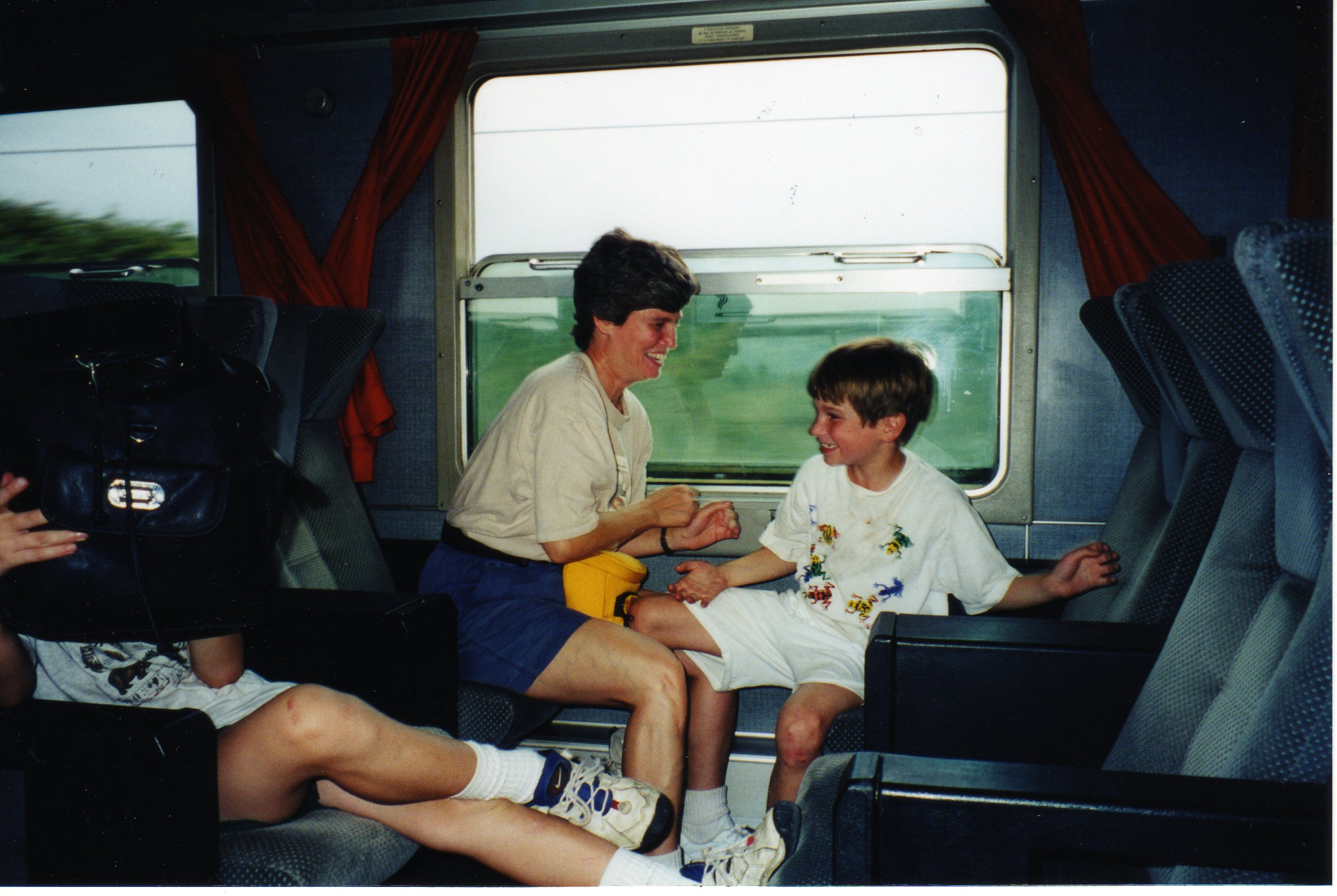
EuroTrains1007
Eve and Glen on our imagined European trip..

But we wanted to see if we could make our vision a reality. We all remember that trip; we visited France, Italy, and Switzerland by rail pass. Eve and I thoroughly enjoyed every minute we spent with our children. They enjoyed their time with us.

I can attribute most of my disappointments as a parent to a failure to remember or apply the things I learned on that flight in 1996.

It is better to keep a goal in mind and make up rules along the way than to follow rules and lose sight of the goal.

Sublimation

© 2007 Brooke Allen
brooke@brookeallen.com www.BrookeAllen.com
Originally published in International Family Magazine

“Granddad, something’s different.”

“What’s that?”

“I haven’t seen you smoking a cigar since we got here.”

“I quit a year ago.”

“Why? I thought you loved those things.”

“Nope. I hated them.”

This was puzzling. “If you hated them, then why did you smoke.”

“It started in the 1920’s. I was the head of the United Press office in Havana. The other men in the office told me that, since I was the highest paid man there, it was entirely appropriate, expected even, that I have a mistress.”

“When I told your grandmother that everyone thought I should have a mistress, she blew a gasket.”

“When she finally calmed down, she said, ‘I guess I have been too strict. I will allow you just one vice, but a mistress is out of the question.'”

“Since cigars were so cheap in Havana, I took up smoking.”

“You didn’t like cigars?”

“No. I hated those things.” He laughed, “I wanted a mistress.”

“So, why did you quit.”

“Anne told me that for my 80th birthday I could have a mistress, so I quit.”

That was interesting, “So, now do you have a mistress?”

“No. It is probably too late and I’m not really interested. But I’m sure glad to be done with those cigars.”
Find alternatives to doing the wrong thing.

Hobbies are good. Carcinogens are bad.

Holiday Remembrances

© 2006 Brooke Allen
brooke@brookeallen.com www.BrookeAllen.com
Originally published in International Family Magazine

I find holidays are an important time to pause and remember things. These days I’m getting older so I do the pause quite well, but the remember part… well… I’ve decided to keep notes.

Thanksgiving is a time to remember how much less I weighed November a year ago. Now that our son goes to McGill in Montreal, it is also a time to remember that they celebrate their Thanksgiving in October and they celebrate mid-term exams at the end of November.

Christmas is a time to remember who sent us holiday cards last year. It is also a time to remember that a bunch of Christians got all whacked about calling them “holiday cards” instead of Christmas cards. Maybe I don’t need to send cards to everyone this year.

Chanukah is a time when I remember that I took an accounting course at Baruch before transferring to New York University.

Easter is a time when I remember that, as pre-teens my sister and I were given two rabbits named Bach and Beethoven. Beethoven turned out to be a girl. Within two years we were feeding more than one hundred rabbits every day after school. I never once saw a single one lay an egg.

On July fourth I remember how much fun an M-80 can be in a trash can.

On secretary’s Day I remember when there were secretaries. 1990 was the first year I noticed there were no secretaries in sight on site, so I sent cards to every generic secretary I could think of, along with a few bucks and a suggestion they buy themselves a small present or a drink. After all, if I had a secretary, I would have sent them out to buy something. It’s part of the job description

Only two replied. They were:

Elizabeth Dole, then Secretary of Labor, and,

Edward Derwinski, then Secretary of Veterans Affairs.

I think they must be really decent people.

Holidays can be stressful. Humor helps.