What questions should we ask ourselves?

Woman in Mirror by Dennis Brekke - creatie commonsResearchers have shown that it if you want to do something it is better to
ask yourself questions rather than to tell yourself things.

Ask, don’t tell

by Brooke Allen

If you want to exercise today then it is not a good idea to get up in the morning and say, “I will exercise today.” This tells your unconscious that the issue is settled so there is nothing to do. Of course, as you go to bed you might say, “Gee… I forgot all about exercising.”

Instead, ask yourself, “Will I exercise today?” This question can only be answered in the affirmative by actually exercising, and this makes it much more likely that you will actually exercise.

The Lens of MotivationI have used this in the design of the 54 questions to ask yourself that I’ve printed on a deck of playing cards. You can use these to design a personal philosophy of life, and you can find them at LensGame.com.

Question form

I call my questions “lenses” and they are in the form: “Because X, ask yourself: Y.”

Some examples:

The Lens of the Boss: Because it is important to know who will bear ultimate responsibility for your life, ask yourself: Who is the boss of me?

The Lens of Needs: Because we survive and thrive by meeting each other’s needs, ask yourself: What do I need? What is needed of me?

The Lens of Followership: Because followers have responsibility too, ask yourself: Have I chosen my leaders wisely? Am I blaming my leaders for things that could be my responsibility instead?

Help us make work more fun

Following on the success of The Lens Game, I’ve begun working on “Work as Fun” ― a series of questions to ask yourself that can help you make work more fun. After all, as Mary Poppins said, “In every task that must be done there is an element of fun. Find the fun and – SNAP – the work’s a game.”

What questions do you think should be included in this project?

Remember, the form of the question is “Because X ask yourself Y” where X is an irrefutable reason for why the question is important, and Y is in the form of a “first person interrogative” – which is fancy talk for a question that you ask yourself.

Here are some examples appropriate to making work fun.

Lens of Fun: Because fun is hard to define and it encompasses much more than just pleasure, ask yourself: What does fun mean to you?

Lens of Optionality: Because it is no fun to be forced to do something, ask yourself: How can I see something that must be done as a choice I make voluntarily?

Lens of Leveling Up: Because what was once fun can become boring once you’ve mastered it, ask yourself: How can I up my game?

What do you think?

Because many brains are better than one, I ask myself: What ideas might my readers have for questions you can ask yourself?

Send me the questions you think everyone should ask themselves if they want their work to be more fun.

I am at: Brooke@BrookeAllen.com

Thanks,

Brooke


Do Traders and B-School Grads Play Fair?

I am a securities trader with a business degree, and I wonder if we are like normal people.

Let’s find out.

Imagine $10 has to be split between two people who will never meet each other. The first person can propose how the money will be split and if the second person accepts the proposal then that is how it is distributed. But if the second person refuses then neither gets anything.

Although this should be enough to understand the question, you might enjoy reading this article in Quartz called  Can You be Greedy Without Being Selfish.

____________________________

Please take this quick survey:

[contact-form-7 id=”1072″ title=”UG_2234U241″]

____________________________

Should Caring Be Part of Every Job description?

About a decade ago someone in accounting, or personnel, or wherever, asked me for job titles.

I said, “We don’t have job titles in our group.”

She went away.

Soon she was back saying that a new policy required that we have job titles, and that I had to give them some.

I said, “I can’t think of any.”

She said, “Make something up.”

I said, “OK, we’re all Senior Executive Vice Presidents.”

She went away.

She was back the following day saying, “Those titles won’t do. Nobody in your group is a vice president, senior, executive, or otherwise. Besides, we need functional titles.”

“As opposed to bullshit ones?” I asked.

She didn’t laugh but waited around until I came up with some stuff… Group Head (me), Analyst, Programmer, Trader … make that Senior Trader (never mind that we don’t have any junior ones)… I don’t remember and don’t care, although I can now find out if need be by asking everyone in my group for their new business cards.

Since our first day in the mid-1990′s, we have had a daily checklist, similar to what pilots find in airplane cockpits and janitors find on bathroom walls: do this by 8:15, start that computer before this one, run that program, file this report by 5:00, etc. The checklist gets updated as needed and has gone from perhaps 15 items to over 50 in 16 years.

A while ago our organization was restructured to come under a German parent, which meant that now we became subject to new regulators and rules. Auditors from Frankfurt arrived and were very impressed at the length and detail of our check-list, and apparently it got a glowing stamp of approval.

But they were back, and with a frown, said, “We can’t find your job descriptions.”

I said, “That’s because we don’t have any.”

“That won’t do; how can you run a business like that?”

I pointed out that we’d been doing fine for over a decade, but they would have none of it, and demanded something pronto.

I said, “We all do what needs to be done.”

They were not amused. They gave me a sample of what they wanted that looked like a checklist for somebody else. I complained to someone in compliance, and she explained that we must now comply with new German risk rules that require detailed job descriptions, among other things.

So we complied and divided up the checklist, assigning things by who does what. They were satisfied and went away.

However, the German regulators, (who are “principles based,” rather than “rules based” as are the regulators in the USA), our management, and everyone in our group all know that compliance with rules isn’t enough, and faithfully following a task list alone isn’t really doing your job.

We have a mission statement specific to our group which states, “Our goal as a group is to act such that every person associated with our endeavor will feel that at the end of the day they were better for it.”

We have a detailed document itemizing who exactly those people are, and we update it when stakeholders change. We document our principles and values, and update them too, although infrequently, since they seldom change. We have procedure manuals that remind us of how to do things, policy manuals that tell us what and why, and checklists that help us remember when to do things, and document when we forget.

But a job description is not doing its job if it only lists tasks better itemized in a checklist.

In essence, we all have only one job description, and that is “to care.”

All jobs and their descriptions must begin with an understanding of what it means to care, about what, and for whom.

Karma – The only currency the IRS cannot tax and the FED cannot devalue.

by: Brooke Allen
brooke@brookeallen.com www.BrookeAllen.com

The InterContinental Hotel Group (NYSE Ticker: IHG) is the largest hotel group in the world with seven brands (Intercontinental Hotels, Crowne Plaza, Hotel Indigo, Holiday Inn, Holiday Inn Express, Staybridge, and Candlewood Suites). They claim more than 645,000 rooms in over 100 countries.

priorityclubIf I take the time to join their “Priority Club Rewards” program, I get exclusive benefits like a free newspaper once a week. After I accumulate 20,000 points I get additional goodies such as Priority Check-In and a special phone number so I can wait less time on hold. Points are easy to accumulate because many of their rooms cost more for one night than I spent for an entire semester’s college tuition.
As a Club member, they would begin collecting information about me and my preferences so they can tailor an experience just for me. They promise not to release that information to anyone – not even me.

I never bothered joining. Unlike many, I can afford their rooms without going into debt to the credit card company. The issue is time, not money – my life is too short, and I don’t want to spend my time with them.

Instead, I belong to a different club, one with more space than InterContinental in more than twice as many countries. And my club is adding 14,000 members and 4,000 rooms a week.

And every one of those rooms is free.

cs-profileMy club is run by the Couch Surfing Collective. Although membership is free, four years ago I chose to donate about $20 and they verified that I was who I said I was, and I lived where I said I lived.

Couch Surfing members don’t have membership cards but rather online profiles that can be seen by all 1.8 million members. Other members write references, which can be positive, neutral, or negative – and all references appear on your profile, whether you like it or not.

Right now, I have over 70 positive references (and no neutral or negative ones), and therefore strangers all over the world will welcome me into their homes without any money changing hands. But if I stop Continue reading “Karma – The only currency the IRS cannot tax and the FED cannot devalue.”

Second Greatest Generation

by: Brooke Allen
brooke@brookeallen.com www.BrookeAllen.com

Paul Krugman wrote a piece in the New York Times in which he wonders if Congress will vote on a stimulus package to head off the Great Depression II.

Some believe that it was World War 2 that got us out of the depression because it was the greatest stimulus spending package of all.

I disagree. I believe it was my father’s generation, the Greatest Generation that fought the War and that got us out of the Great Depression.

People, not policies, got us out of our predicament.

The NY Times published my letter.


GreatestGeneration2

Recently, I reprinted the letter and illustrated it with stamps from my collection. The top contains U. S. stamps, and I notice they feature leaders and statesmen. The 3 cent stamp to the right commemorates the National Recovery Act of 1933, and it shows a woman, a businessman, a factory worker (with a hammer over his shoulder), and a farmer with a sickle, all walking side by side. There was no inflation during the depression (in fact, there was deflation.)

By way of contrast, Germany had rampant inflation. All the German stamps in my collection are un-cancelled. By the time a postage stamp made it to the post office it was worthless. The left-most stamp is for 10 marks, the rightmost 20 billion! Eventually it took a strong leader to get the economy under control… and we see who that was.

Stories from Germany

by: Brooke Allen
brooke@brookeallen.com www.BrookeAllen.com


luftwaffeA Luftwaffe Airman’s Daughter

In 1980, my girlfriend and I were traveling on a rail pass. We left from Milan bound for Frankfurt only because that is where the train went.

A German businessman sat across from us and asked, “Where are you going?”

“Frankfurt.”

“Why? Frankfurt is so boring. You should go to Wiesbaden instead.”

We asked, “Why?”

“Because that is where we live and you will stay with us.”

His wife spoke English with a perfect British accent. It turned out her father had been in the Luftwaffe and had been shot down during the Battle of Britain. He became best friends with a prison guard, and after the war during the summers they would swap children. She grew up partially in England.

She said the difference between the treatment of prisoners by the British and the Germans was astonishing.

We all cried.

We were there having dinner with them because they had decided to make it a habit of being kind to strangers; which is not a bad policy even when the stranger had recently been trying to blow up your country.

treblantwoman

Beautiful Women of the GDR

I won a British Airways contest based on my social entrepreneurship site, No Shortage of Work, and the prize was airfare to anywhere BA flies. I put a notice on my profile on Europe’s equivalent of LinkedIn called Xing. Dozens of people said they would love to meet me in person so I flew into Frankfurt, then Cologne, and flew out of Hamburg and for 11 days I spent my time meeting people in person I’d only corresponded with before on Xing.

Although my sample size is very small, I have the following observation:

The most interesting, dynamic, interesting, hard-working, fearless, and interesting people I met were:

1) Female

2) Beautiful

3) From East Germany, but were now in the West.

4) Were born under Communism, but grew into adulthood after the fall of the Wall.

My sample size was small and I am partial to young beautiful women so perhaps that is why I find them more interesting than old male businessmen like me, but I still think there is something to this.

What do you think?


germanunemployment

An Unemployed German

In 2004, in Nuremberg, I met Kai, a very talented 51-year-old programmer who had been unemployed for 2 years, so my wife and I took him to dinner. His attitudes were self-defeating and I attacked every one of his beliefs:

“The economy is terrible.”  So, are you just going to wait for it to improve?

“The government is incompetent.”  Are you going to run for office and fix it?

“I’ve only had 2 interviews and they both ended abruptly when they learned my age.”  People are prejudiced. Do you have a plan for how you are going to change them, or are you going to take a different approach?

“I don’t have a college degree.” That hasn’t stopped you for 30 years.

“Nobody cares.” There is a whole community of programmers just like you. Are you going to continue ignoring them or are you going to start caring about them and see if they care back?

“There is no work.” There is never a shortage of work even when there is a shortage of jobs. Find some work and do it even if you aren’t paid.

“I’ve built some amazing software on my own, but can’t sell it.” Are you going to learn to sell, partner with someone who can, or give up on doing what you want and start doing what other people want?

“There are no jobs in Germany.”  You’re in the EU now so you can go where there are jobs.

“My English isn’t good enough.”  Sure it is; I understand you perfectly. If you don’t understand me it isn’t because of your language skills, it is because of how you are thinking.

My wife kept kicking me under the table and whispered, “He just wants your sympathy.”

I said, “Perhaps, but it isn’t what he needs.”

We were living in London at the time and he even flew over to spend a weekend with me to get more of my abuse.

Soon he got unstuck and landed a job in Copenhagen (good pay, company apartment, flight home every other weekend) and a year later he moved to England for another job.

Kai and I have become good friends and my wife and I stayed with him outside London in November 2010.

He says he hates going back to Germany because too many people there think the way he used to.

I was speaking to a group of programmers, many of whom were looking for work. I asked Kai to write a short essay explaining what he learned, and how he changed his approach to what some call “networking.” Here is what he produced:

KaiStory

Game Design for Amateur Radio Contesters


towerstack
My main tower at our country house – in operation from 1988-2014

(c) 2013-15 by Brooke Allen

I am an amateur radio operator with a particular interest in radio contesting, in which thousands of radio operators all over the world will spend an entire weekend talking to each other.

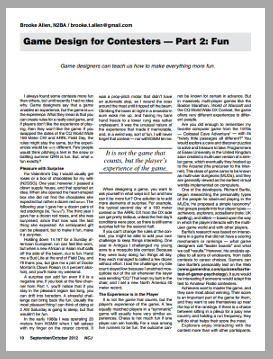
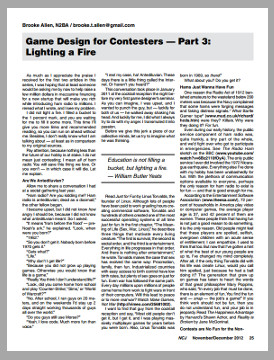
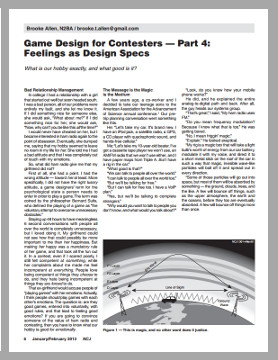
I have just completed a series of articles on game design for the National Contest Journal, which is the premier magazine for our hobby.

The articles might be of general interest because they also talk about principles that apply to everything that might be fun or keep you in flow. If you want to know how I use the word “flow” then read the articles.

part1

Part 1 – Flow

part2

Part 2 – Fun

part3

Part 3 – Lighting a Fire

part4

Part 4 – Feelings as Design Specs

Holiday Greetings


SUGGEST YOUR OWN CAPTIONS

“I would go back to the drawing board if it hadn’t been repossessed last week.”

“Given the economy, and now that you have written the proof that two can live as cheaply as one, I guess I will marry you.”


This cartoon was suggested by Brooke Allen, illustrated by Alicia Reeves, and published in the November 21, 2008 on-line edition of Science Careers Magazine in the story Finance’s Quant(um) Mechanics.