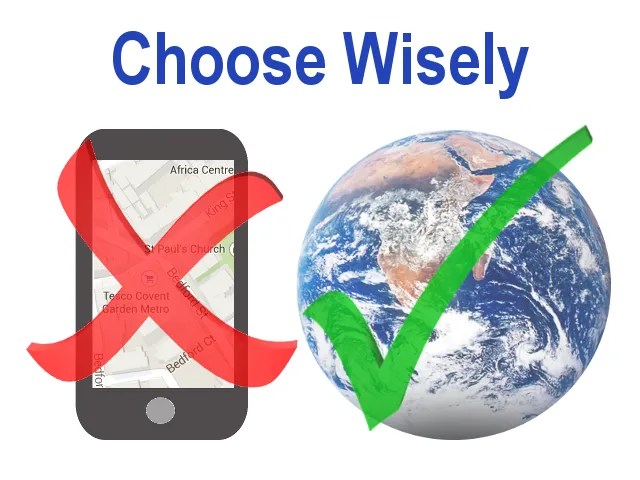
Do you ever get lost in the World Wide Web?
Early Saturday morning before going shopping you decide to find a recipe for breakfast soufflé and the next thing you know you’ve visited 37 sites and watched half a dozen TED videos, and now it is past lunchtime and you’re starving and so you search for a recipe that can make best use of what’s in the kitchen: 6 ounces of sharp Vermont cheddar, a pickle, and four pieces of salt licorice.
If this hasn’t happened to you then I hate to break it to you but you’re not normal.
But do you do the same carefree flitting about in the real world?
If you haven’t tried it then you should; it’s awesome — like a truly interactive 3-D immersive hi-def IMAX experience with Dolby Surround-Sound and Smell-O-Vision. Only better.
For example…
On the morning of Saturday, September 6, 2014 I wake up in a rented room in Beit Hall at Imperial College, South Kensington, London. I have only two things on my calendar: 1) a late lunch with a guy I’ll call Fred at 2:00 PM at Ottelenghi restaurant on Upper Street in Islington, and 2) dinner in Covent Garden with my friend, Kai, who I first met in Nuremberg, 2004, and who I talk about in Stories from Germany.
I have only 20 pounds and tube pass in my wallet so my first order of business is to find a Barclays ATM and withdraw some cash. My iPhone tells me the nearest machine is not far away but I still manage to take 30 minutes finding the place — partially because in London they change the names of streets every block, and partially because sometimes I’m an idiot.
When I get to the ATM it says it is out of order.
I’m about to ask my iPhone to find the next machine when I say to myself, “This is stupid.”
The thing is, when I was 19 a friend and I took a week off work and with $20 in our pockets we hitch-hiked from New Jersey to California and back in nine days. When you go on an adventure like that it is good to have a purpose and a clearly identified destination, and in this instance our purpose was to take an ounce of the Atlantic and put it in the Pacific and then return with an ounce of the Pacific for the Atlantic. Oceans make for good targets because they are hard to miss, the sun will tell you east from west, and you know when you’ve arrived because your feet start getting wet.
We did all that without fear, an iPhone, or even a watch and we didn’t worry about getting lost because wherever we were there we were. And in the event we needed to know the name of the place we were at or which way to the ocean then someone who knew the answers always seemed to be loitering nearby.
Standing in front of the ATM I look at my iPhone, note that it isn’t even 10:30, and I turn it off. I figure that if I cannot make my way to a restaurant across town in 3.5 hours then I’ve become really stupid in the 42 years since I was 19.
I ask a woman to point me at the nearest tube station. I walk for a while and ask someone else for a mid-course correction and he sends me down another street and I find it. I ask people how to get to Islington and a surprising number say they have no idea but soon a young couple says, “Come with us, we’ll tell you on the way.” They ask where I am going in Islington because there are a bunch of stops in that borough. I say I have no idea and ask if any of the stops have the word “Islington” in them and they suggest Highbury & Islington. We chat a bit and when we part I say, “Remember to live life as an adventure.” He laughs and she says, “Is there any other way?” I feel hope for the young.
As I exit the station I ask an attendant if he knows Ottelenghi on Upper Street and he says he doesn’t but it can’t be hard to find because we are at one end of Upper Street so there is only one way I can walk. I step onto the pavement and across the street is a Barclays bank so I take out 200 pounds.
Soon I am at the restaurant. Nearby is a bench so I sit down next to a man and ask for the time. It is well before noon. I ask him what he does. He’s a plumber. There is a building across the street that is being completely renovated and he explains what they are doing in fascinating detail. It reminds me of my first job when I turned 16 and my dad dropped me at Bolek’s Foreign Car Repair and said, “This is my son. He needs to learn how to work and get his hands dirty.” Then he gave Bolek $100 to cover any damage I might do. He said “Don’t pay him; he isn’t worth anything,” and then he drove away. So that is how for about a year of Saturdays I learned how to work, get my hands dirty, and become worth something.
I ask the man on the bench if he ever gets depressed. He says, “No. That’s because I do an honest day’s work for an honest day’s pay.” Funny, I think, that is what my dad used to say. I wonder if doing an honest day’s work is listed somewhere in the DSM as a cure for mental illness.
The restaurant fills and overflows into the street. Because there is still loads of time I resist checking Yelp and instead I start walking around the neighborhood scouting alternatives. After finding a few I return to the bench, take out my notebook, and begin recording the events of the morning in case I need to remember them.
When Fred arrives we move to a quieter place, and after ordering I ask him for his purpose in life and he says it is to realize the potential in others and himself. He asks me the same and I say I want to be of meaningful help to over-educated Westerners. I ask who is important to him and he says, “The next generation” and we both agree on that. I ask where he works and he says he works in the finance industry and his job is to hire people of good character and help them find meaning in their work instead of just money.
We hit it off and we talk for hours.
Fred has an appointment with a barber so I walk him there and ask him to point with his finger in the direction of Covent Garden.
I begin walking. After a while I need to pee so I go into a pub and ask if it would be OK if I use the WC without buying a drink. There is a large crowd of older men in attendance and one says, “Come on mate, have a pint.” I ask what time it is. “Half four.” I say it is too early. Someone says, “Not if you’re an alcoholic.” I ask, “Are you an alcoholic?” and he says, “Of course; we all are.”
I really have to pee, so I do, but I return to the bar and have a wonderful conversation with perhaps a dozen tradesmen about their life and work and they both convince me that they are indeed alcoholics and also impress me with their insights. As I leave, one says, “We may be drunks but at least we do honest work.”
I ask a bus driver if he can get me to Covent Garden and he says, “Close enough.” So I go upstairs (It’s a double-decker) and I sit in the very first row.
After a while I announce to the other passengers that I want to go to Covent Garden and someone says, “That was the previous stop.” So I get off and find a woman standing in a doorway of an office building smoking a cigarette and thumbing her smart phone. I ask her if she knows how to get to Covent Garden. She removes her ear buds and asks me to repeat the question. I do, and she says she knows it is nearby and offers to look it up. I say that’s OK; I’m trying to go electronics-free for a day. I ask what she does and she explains that she works in the building and often eats at Covent Garden for lunch but she doesn’t know how to get there. She says this as if there is nothing strange about the admission.
I ask a few other people and get mix of “don’t speak English” and “I know it is around here somewhere.”
Then I stop a very old couple leaving a shop.
I ask, “Can you tell me how to get to Covent Garden?”
He says, “I can.”
After a long pause, I get the joke and begin laughing. So I ask, “How come nobody knows where anything is any longer?”
He says, “Because everyone has gone stupid.”
We talk a bit and he says he resents how young people act as if old people grew up retarded. He says “How do they think we won World War 2?” and I say, “Yea, my dad would say that every generation thinks they are the first to invent sex.”
We chat a bit longer and finally he says, “If you want Covent Garden, go half a block that way, cross the street and you’ll see it right in front of you.”
I’m about to do that when I notice that the store the couple came out of was called STAMP CENTRE. I collected stamps as a kid (as did most of my friends) but for decades I hadn’t seen an actual stamp shop so I go in and ask one of the guys in the back how they stay in business. He says that in the front of the store they sell toys and in the back they sell stamps. The toys pay the bills and the stamps give them a reason to go to work.
I say that in college for some reason I became obsessed with stamps and then one day my girlfriend found me on my bed surrounded with albums, catalogs, and stamps both on and off paper. She said, “I see there is no longer room in your life for me,” and then she left. I shouted after her, “That’s not true; I love you.” But once we broke up I lost all interest in stamps.
The man behind the counter says, “Resentment is like an embalming fluid because it can mummify your soul.”
I am flabbergasted, “Who said that?”
“I did,” the man says, “I’m just repeating what you told me. You wanted to break up but rather than resent your girlfriend you became interested in stamps and that protected your soul. Once she was gone you didn’t need the stamps.”
I think about it and it and realize he is right. I write down what he said in my notebook. I ask, “What is your name? May I quote you?”
He says, “No. When you need those words then you say them and they will be yours.”
I leave the shop, turn right, go half a block, cross the street, and run into a silly looking man dressed in a suit and wearing what looks like a plastic bowler hat. On his lapel is a circular pin with a lower-case “I”
I ask, “May I ask a question?”
He says, “Sure.” He points to the pin. “That’s what I am here for; I answer questions.”
I ask, “What is the most common question you are asked?”
He says, “Where is Covent Garden?”
“So, where is it?”
He turns and points: Right there at the end of the block. You can see it from here.”
I ask, “Why do you even need to be here?”
He says, “I know, it’s idiotic; nobody knows anything anymore. It’s like hotels.”
“Hotels?” I’m puzzled, “How is it like hotels?”
“Well it used to be that when you would travel as the sun went down people would ask if you needed a place to stay. But then we invented hotels and now there are fewer places to stay and things got expensive.”
I think of my friend, Kent, who in his 60’s rode a bicycle from Hanoi to Ho Chi Menu City. When school let out kids would ride with him and practice their English and later sometimes people would offer him a place to stay.
I ask the man in the funny hat, “Where are you from?”
“Morocco?”
“Why are you in England?”
“I’m studying computer science.”
“Do you think you will go back to Morocco?”
He says, “Of course; you guys don’t know shit about how to live.”
I walk to the end of the block and ask a young couple with a foreign accent if they know where the Royal Opera House is and they tell me it is hard to see but it is diagonally across the square.
I apologize and say I probably could have found it myself and girl says, “That’s OK. People go on the internet to meet strangers but that is stupid because there are strangers all around them.”
At the Opera house I discover I still have loads of time before meeting Kai so I find a street magician and become enthralled with his act. The tricks aren’t the point of his show but instead he is constantly interacting with the audience in a way that is both funny and profound. A woman passes pushing a stroller, “Hey you!” The woman stops and looks up, “I wasn’t talking to you; I was talking to the baby. Don’t let her push you around.” Then to the mom, “Watch what you say because you’ll need him to push you around soon enough.” In order to bring the audience closer he says, “To move forward start by moving your feet and the rest of you will follow.” He has dozens of gems like these and when he passes the hat I give him a fiver and tell him I was impressed that everything he says is both a joke and a useful life lesson. He says, “But of course.” I ask for his name in the event I ever want to write about him and he gives me his card; it says: Nick Stein.
There is still time so I buy a copy of The Big Issue from a street vendor who looks a bit down on her luck. I ask if she was homeless and she says she isn’t but probably would be but for this job. We talk a bit about Eddie Izzaard who is featured on the cover, and she says Izzard would make a better Mayor of London than comedian and besides she really prefers the black Americans like Eddie Murphy and Chris Rock. She talks very eloquently about the articles in the paper — she has read them all — and when I leave I get the impression that even if she doesn’t have all her teeth she has all her marbles.
At seven I meet Kai and in front of the opera and we find a place, have dinner, and catch up.
On the way back to Imperial College just outside the South Kensington station I meet another Big Issue vendor so we talk a bit about what’s in the paper and about his life. He is black, perhaps 30, and his name is Mark. He buys papers at a pound-twenty-five and sells them for two-fifty. He sells three to four hundred a week and that is plenty to pay for a one room apartment with a shared bath. I ask if he minds if I talk to him and he says he enjoys it and it is no distraction from selling because all he does is stand there and people come to him. And indeed they do; many even greet him by name.
I ask Mark if I can get him a drink and he says he doesn’t drink. I say, “I don’t mean alcohol, I mean like water or juice or something.” He says, “Oh, sure, I like orange juice.” He tries to give me a pound coin but I pretend not to see and I trot off to a shop. When I return I hand him the bottle and he tries to give me a coin again. I say, “No, it’s a gift.”
His eyes widen and his smile broadens and he exclaims, “A Gift. Thank you. A Gift.” He exudes gratitude in a way we wish our children would on Christmas morning. I tell him that I love talking to buskers and street vendors and even homeless winos because they usually have great stories.
And then I ask him for advice.
There is one woman I know with a very kind heart and she will often give money to beggars and buskers but she gets really annoyed that I talk to them, and she’ll refuse a handshake when offered, and if I shake their hands she’ll make me wash mine before I can touch her. I think it is disrespectful.
Mark says, “It wouldn’t bother me. Whatever she does it is about her, not me.” He laughs.
I ask, “What should I do?”
He says, “Forgive her. Why are you even thinking about it? Forgive her.” Then he confesses that he doesn’t understand women and he tells about how one customer would buy a paper from him every week. She was beautiful and classy, a medical doctor, and they would have great conversations and eventually he fell in love with her and asked to take her for dinner. She was offended at first but he persisted and it took over a year but eventually she relented and he took her on a date.
I ask how it went and his face droops and he says that it wasn’t what he’d hoped; she didn’t seem proud to be with him and his love for her faded. Then his smile returned and he says, “I’ve given up trying to understand women.”
A great throng of people come down Exhibition Road toward us and Mark says, “A show must have just let out at the Royal Albert.” I suggest that I should leave him to do his selling and he says there is no need. And sure enough as we talk people stop to buy his paper without him making any effort.
Eventually I thank him for his time and excuse myself, and he laughs and says, “No. I thank you.” As I walk back to Beit Hall I hear him laughing and calling “Thank you… Thank you.” I turn and he’s waving. I wave back.
I turn on the phone and the battery is fully charged. I turn it off immediately before it has a chance to download emails. As I drift off to sleep I think about what a wonderful day it has been. Then I remember that when I was a child every summer was full of days like this except with frogs and fish and deer and trees and other kids and a pond and a slingshot and acorns and an old abandoned mine and a barn full of hay bales and rabbits and so much more; and it felt like there was magic and meaning in everything.
You might have a feeling that my story has taught you something but it’s a feeling, not a fact. This story, while true, is entertainment, not real education. If you want to learn about the world then you have to live in it first-hand and there isn’t a story, a website, or an app for that.

 Brooke Allen
You always inspire me, Brooke. Your ability to befriend strangers everywhere you go just by listening to their stories is your superpower! Write on! 73
LikeLike