College Thinking

© 2007 Brooke Allen
brooke@brookeallen.com www.BrookeAllen.com
Originally published in International Family Magazine

Colleges have become marketing experts. They work very hard at convincing you to send them your child and your money. You have to do the work yourself to find out why you shouldn’t send them either.

“Admissions.”

“Hello, is this (name of a liberal arts college in the Midwest)?”[1]

“Yes it is.”

“Are you an admissions officer?”

“Yes I am.”

“I am calling regarding my son. He has been admitted to your institution and he’s trying to decide if he wants to go. He isn’t here now so do you mind if I record this conversation for him?”

“Not at all.”

“Great. My son is a very good student but he is not yet ready to narrow his interests. He feels that a liberal arts college might be just the thing for him, at least as an undergraduate.”

“We fit the bill.”

“Personally, there is only one thing that I’m hoping he gets out of college more than anything else.”

“What’s that?”

“I would love it if he learns how to think.”

“Excellent. We’re in agreement. More than anything else, that is what we’re all about.”

“I’d like him to learn how to tackle problems with insight and creativity.”

“We agree.”

“I’d like him to respect authority and yet feel comfortable questioning it.”

“Perfect.”

“I’d like him to develop his people skills and to become responsible.”

“Couldn’t agree more.”

“I’d like him to learn to make his own decisions without requiring the approval of his peers.”

“We teach independence and responsibility by example. The college puts a great deal of trust in its faculty, staff and students to make decisions on their own.”

“I’d hope that he’ll find a place that facilitates this process rather than gets in the way.”

“That describes us to a T.”

“Good. Now, I have a question. Do you require that freshmen live on campus?”

“Actually, we require all students to live on campus their first two years.”

“No exceptions.”

“Well, we do make rare exceptions for hardship.”

“Do you mean, as in a case where we live in town but we don’t have enough money to pay for tuition and room and board? However, we could swing it if he lives at home.”

“We feel very strongly about this. We’ve found it is important for freshmen to develop strong relationships with other freshmen and these relationships are solidified in their second year. So, in the case of financial need we’d give him enough aid so that he could live on campus.”

“Like a grant?”

“Or a loan.”

“Ok, so you feel it is so important you would have him to go into debt. Now, imagine that the fact is that he has inherited a house right in town. It has four bedrooms and it has a market value of $160,000. Your college costs $47,000 a year all in. Since he has clear title, I doubt he’d qualify for a grant based on financial need. Are you saying you’d force him to sell the house and still go into debt so he could give you the money and live on campus when he’d rather take roommates and live in his house?”

“No. That would certainly qualify for an exemption. He could have seven other roommates since the town zones houses that way for students. He could collect enough rent from his roommates to pay all his other expenses.”

“That’s what it seems like. Rather than liquidate the house and give you all his money he could graduate from college with an education and a house free and clear.”

“Correct. And managing a property like that will certainly teach him responsibility. I’m sure I could get an exemption for him.”

“And seven other students.”

“What do you mean?”

“Well, you want him to live with other freshmen. You said so yourself.”

“That could be a challenge, but I’m confident we could do it.”

“Excellent.”

“I’ll form a committee right away.”

“Great. We’ll call a realtor.”

“What!?”

“He doesn’t own the house yet, but there are some excellent properties just steps from your main gate.”

“Wait a minute. This is totally different. What are you trying to do?”

“I’m trying to teach him how to think.”

“What you’re teaching him boarders on the criminal.”

“No, I’m teaching him how to tackle problems with insight and creativity.”

“But we have rules for a reason.”

“Is the reason you have rules to avoid thinking? The only difference between my son and the boy you would exempt from the rules is that my mother has not yet bought my son the house.”

“You’re teaching him how to trick people. If he thinks like you do then he will not be welcome here.”

“That’s what it seems like.”


Some colleges don’t want you thinking the way they don’t.


[1] This conversation is completely fictional and any resemblance to any real conversations I might have had with small liberal arts colleges in the Midwest is purely coincidental.

Environmentalist, Get Thee to an Editor

© 2007 Brooke Allen
brooke@brookeallen.com www.BrookeAllen.com
Originally published in International Family Magazine

Polychlorinated Biphenyls (PCBs)[1] are neurotoxins and potent carcinogens that were once used extensively in cooling oils for electrical transformers back when we were fearless (and stupid).

Transformers can overheat and catch fire. Breathing the smoke from a burning transformer containing PCBs can put firemen at more risk than they signed up for.

At the train station in Hoboken, New Jersey, I spied a large transformer with a sticker on it that said:

“NO PCBs”

What did this sticker mean?

Did a protestor place the sticker there thinking he was working in the best interests of workers, firemen, and the general public?

Or did it mean that the transformer had been tested and was free of PCBs?

A falsely reassure a maintenance person or a fireman might put himself at great risk. Or he might take it as a warning and fail to put out a fire putting others at risk.

These two words (well, one word and an acronym) take my prize for the shortest ambiguous sentence.

Don’t believe what you can misread.


Ambiguity is the soul of the nitwit.


[1] Replacing more than one of the hydrogen atoms in a biphenol with chlorine atoms produces a Polychlorinated Biphenol; but you knew that already just from the name.

Imagine a Future

© 2007 Brooke Allen

Being a dad wasn’t working out as I’d hoped.

I grew up on “Leave it to Beaver” and “Father Knows Best”.

Our home was more like “The Simpson”s or “Married With Children”.

That January I found myself on an airplane sitting next to a woman who is a psychologist and an expert on rearing children. I asked her for advice on how to be a better dad.

We talked for hours and she had many sensible suggestions. As we approached Kennedy Airport, she said, “Well, there really isn’t time left to get into much depth, so let me ask you a simple question.”

“Sure.”

“Can you imagine you and your family in some idealized future setting?”

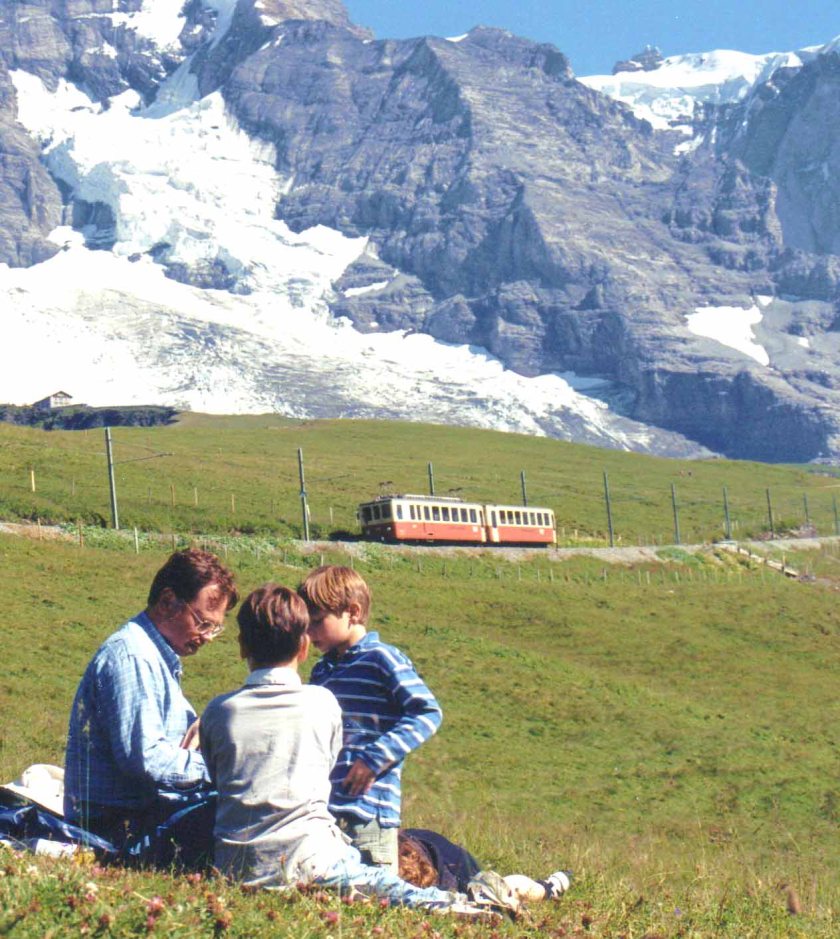
Alps1
The future I imagined with my sons in the Alps.

“Yes.” It wasn’t a hard question, “When I was in college I traveled around Europe on a rail pass by myself. On the one hand I wished that my parents had been with me as we explored things together. On the other hand, I couldn’t imagine that the experience would have actually been a pleasant one.”

“When we had our own children, it was my fantasy that we could be the kind of parents that our children would enjoy having with them on vacation. Right now the thought of spending time together is inconsistent with our concept of a vacation. I’m sure they find our company “no fun” as well. It seems like we spend our days making up rules and enforcing them. They resent all that we do for them. It seems likely I’ll have to give up on that fantasy.”

“That’s perfect,” said my traveling companion. “Imagine what the ideal rail trip would be like. Imagine all of you exploring new things together, sharing experiences, and enjoying each other’s company. Imagine what it would feel like.”

“OK.”

“Good. Have a concrete image in your mind of this trip and set it as a goal. Now don’t concentrate on where you will go, or what you will see, but rather on how you, and everyone else, will feel and how you will interact.”

“OK.”

“Now, as you go through your daily life, each time you are about to do something, think to yourself, ‘Is what I am about to do going to bring me closer to this goal?’ If it occurs to you that what you are about to do now might hurt your chances of reaching your goal, try something different instead.”

I took this to heart. Each time I was about to yell about homework, bath time, or bedtime, I thought again. We found better ways of motivating our children without the acrimony.

In the summer of 1998, less than three years after that plane trip, we planned a vacation in Europe. Other parents assumed we were going as a couple and offered to introduce us to the baby sitters they trusted with their children when they went away. Traveling with their children was inconsistent with their concept of a vacation.

EuroTrains1007
Eve and Glen on our imagined European trip..

But we wanted to see if we could make our vision a reality. We all remember that trip; we visited France, Italy, and Switzerland by rail pass. Eve and I thoroughly enjoyed every minute we spent with our children. They enjoyed their time with us.

I can attribute most of my disappointments as a parent to a failure to remember or apply the things I learned on that flight in 1996.

It is better to keep a goal in mind and make up rules along the way than to follow rules and lose sight of the goal.

Sublimation

© 2007 Brooke Allen
brooke@brookeallen.com www.BrookeAllen.com
Originally published in International Family Magazine

“Granddad, something’s different.”

“What’s that?”

“I haven’t seen you smoking a cigar since we got here.”

“I quit a year ago.”

“Why? I thought you loved those things.”

“Nope. I hated them.”

This was puzzling. “If you hated them, then why did you smoke.”

“It started in the 1920’s. I was the head of the United Press office in Havana. The other men in the office told me that, since I was the highest paid man there, it was entirely appropriate, expected even, that I have a mistress.”

“When I told your grandmother that everyone thought I should have a mistress, she blew a gasket.”

“When she finally calmed down, she said, ‘I guess I have been too strict. I will allow you just one vice, but a mistress is out of the question.'”

“Since cigars were so cheap in Havana, I took up smoking.”

“You didn’t like cigars?”

“No. I hated those things.” He laughed, “I wanted a mistress.”

“So, why did you quit.”

“Anne told me that for my 80th birthday I could have a mistress, so I quit.”

That was interesting, “So, now do you have a mistress?”

“No. It is probably too late and I’m not really interested. But I’m sure glad to be done with those cigars.”
Find alternatives to doing the wrong thing.

Hobbies are good. Carcinogens are bad.